
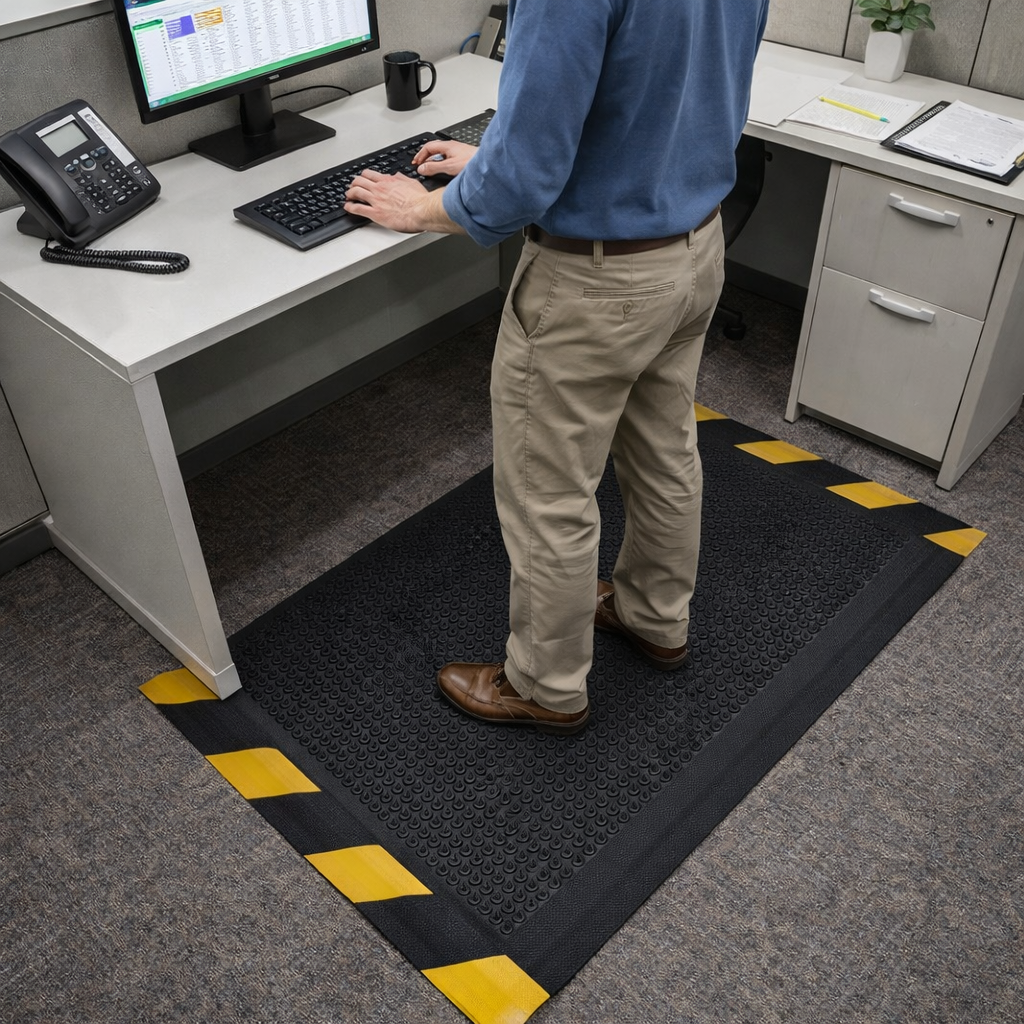
Anti-Fatigue Safety Mat UK 2026: Expert Guide to Industrial Floor Protection
Anti-fatigue safety mats in the UK have become essential equipment for industrial facilities, warehouses, and manufacturing plants across England, Scotland, Wales, and Northern Ireland in 2026. These specialised floor protection systems reduce worker fatigue by up to 50%, improve workplace safety compliance, and deliver measurable productivity gains for businesses investing in employee wellbeing. Whether you're managing a warehouse in Manchester, operating a production facility in Edinburgh, or running a workshop in Cardiff, selecting the right anti-fatigue mat can transform your workplace safety standards whilst reducing injury-related costs and absenteeism.
This comprehensive guide examines everything UK facility managers, health and safety officers, and business owners need to know about anti-fatigue safety mats in 2026, from technical specifications and comparative analysis to installation best practices and long-term maintenance strategies.
Why Anti-Fatigue Safety Mats Matter for UK Workplaces in 2026
The importance of anti-fatigue safety mats extends far beyond basic comfort. In 2026, UK businesses face increasing scrutiny regarding workplace safety compliance, with the Health and Safety Executive reporting that musculoskeletal disorders account for over 8.9 million working days lost annually. Standing for extended periods on hard concrete or tile surfaces creates significant physiological stress, leading to leg fatigue, lower back pain, reduced circulation, and decreased productivity.
Premium anti-fatigue mats address these challenges through advanced ergonomic design. The cushioning properties of industrial-grade nitrile rubber reduce pressure on joints and muscles, promoting subtle movements that improve blood circulation and reduce static loading on the musculoskeletal system. For UK facilities operating under stringent health and safety regulations, implementing proper anti-fatigue matting demonstrates proactive risk management and duty of care obligations.
Beyond regulatory compliance, the business case for anti-fatigue mats in the UK is compelling. Workers experiencing less physical discomfort maintain higher concentration levels, make fewer errors, and require fewer breaks throughout their shifts. The initial investment in quality matting typically generates positive ROI within 12-18 months through reduced workplace injury claims, lower absenteeism rates, and improved operational efficiency.
Understanding Anti-Fatigue Mat Technology and Construction
Not all anti-fatigue mats deliver equivalent performance. The effectiveness of these safety solutions depends on several critical construction factors that UK buyers should evaluate carefully in 2026.
Material Composition: Industrial-grade nitrile rubber represents the gold standard for demanding UK environments. This synthetic rubber compound offers superior resistance to oils, chemicals, and solvents commonly found in manufacturing and automotive facilities. Unlike cheaper PVC or foam alternatives, nitrile rubber maintains its cushioning properties under continuous use and resists degradation from industrial fluids.
Thickness and Density: The optimal thickness for industrial anti-fatigue mats ranges from 12mm to 15mm. This specification provides sufficient cushioning without creating instability or excessive compression under body weight. Thinner mats (6-8mm) offer inadequate fatigue reduction, whilst excessively thick options can create trip hazards and reduce stability for workers performing precision tasks.
Surface Texture: Professional-grade mats feature textured top surfaces engineered to provide slip resistance even in wet or contaminated conditions. The pattern design should balance traction with ease of cleaning, preventing debris accumulation whilst maintaining grip throughout the mat's operational lifespan.
Edge Design: Bevelled edges serve dual purposes in workplace safety. The gradual transition from floor to mat surface prevents trip hazards and accommodates wheeled equipment, whilst high-visibility yellow borders provide clear visual demarcation of safe standing zones. This feature proves particularly valuable in high-traffic areas where multiple workers and equipment operate simultaneously.
Comprehensive Comparison: Premium vs Standard Anti-Fatigue Mats
UK facility managers evaluating anti-fatigue mat options in 2026 benefit from understanding the performance differences between premium, standard, and budget alternatives. This comparison table illustrates why investing in quality matting delivers superior long-term value:
| Specification | Premium Industrial Mat | Standard Competitor | Budget Option |
|---|---|---|---|
| Material | 12mm nitrile rubber | 8-10mm mixed compound | 6mm PVC foam |
| Fatigue Reduction | Up to 50% | 20-30% | 10-15% |
| Safety Features | High-visibility yellow hazard edges | Black edges or no contrast | No safety edges |
| Chemical Resistance | Industrial-grade (oils, solvents, coolants) | Limited resistance | Not resistant |
| Expected Lifespan | 3-5 years heavy use | 1-2 years | 6-12 months |
| UK Safety Compliance | Meets all HSE standards | Variable compliance | Often non-compliant |
| Warranty Coverage | Comprehensive manufacturer warranty | Limited 12-month warranty | No warranty |
| Cost per Year (3-year period) | £82-£95 | £123-£150 | £205-£246 |
This analysis demonstrates that premium anti-fatigue safety mats deliver superior total cost of ownership despite higher initial investment. The extended lifespan and reduced replacement frequency make quality matting the economically rational choice for UK businesses planning beyond short-term budget cycles.
How to Choose the Right Anti-Fatigue Mat for Your UK Facility
Selecting appropriate anti-fatigue matting requires systematic evaluation of your specific operational requirements. UK facility managers should consider these critical factors when specifying mats in 2026:
1. Environmental Conditions: Assess the presence of oils, chemicals, water, or other contaminants in your workspace. Manufacturing facilities and automotive workshops require chemical-resistant nitrile rubber, whilst dry environments may accommodate alternative materials. Temperature ranges also influence material selection, particularly for cold storage or heated production areas.
2. Traffic Patterns and Volume: High-traffic zones demand heavy-duty construction with reinforced edges. Consider both foot traffic and wheeled equipment when evaluating durability requirements. Areas with forklift or pallet jack operation need mats with bevelled edges that won't curl or degrade under repeated wheel passage.
3. Workstation Configuration: Measure standing areas accurately, accounting for worker movement patterns. Fixed workstations like assembly positions or packing stations benefit from precisely sized mats, whilst flexible work areas may require modular systems that can be reconfigured as operational needs evolve.
4. Safety and Compliance Requirements: UK facilities must meet Health and Safety Executive standards for workplace safety. High-visibility yellow hazard edges aren't merely aesthetic features—they serve critical safety functions by clearly demarcating safe standing zones and preventing trip hazards in busy industrial environments.
5. Cleaning and Maintenance Capabilities: Consider your facility's cleaning protocols and available resources. Non-porous surfaces that resist fluid absorption simplify maintenance in food processing or pharmaceutical environments where hygiene standards are paramount.
6. Budget and Total Cost of Ownership: Evaluate costs over the mat's expected lifespan rather than focusing solely on purchase price. Factor in replacement frequency, maintenance requirements, and potential savings from reduced workplace injuries when calculating true economic value.
Step-by-Step Installation Guide for Maximum Performance
Proper installation ensures your anti-fatigue safety mat delivers optimal performance throughout its operational lifespan. Follow this professional installation protocol for UK facilities:
Step 1: Surface Preparation and Assessment
Begin by thoroughly cleaning the installation area. Sweep and vacuum to remove all debris, dust, and loose particles. Inspect the floor surface for damage, unevenness, or moisture issues that could compromise mat performance. Concrete floors should be sealed and cured; tile surfaces must be level and intact. Any floor defects should be repaired before mat installation to prevent premature wear or safety hazards.
Step 2: Acclimatisation Period
If mats have been stored in cold conditions or transported during winter months, allow them to acclimatise to workspace temperature for 24-48 hours before installation. Unroll mats and lay them flat in the installation area. This acclimatisation prevents curling and ensures the material achieves its optimal flexibility and performance characteristics.
Step 3: Positioning and Layout Planning
Position mats according to your workspace analysis, ensuring yellow hazard edges face outward for maximum visibility. For multiple mat installations, plan the layout to create logical safety zones whilst maintaining efficient traffic flow. Consider equipment placement, door swings, and worker movement patterns when finalising positions.
Step 4: Securing and Anchoring
Most premium anti-fatigue mats remain stable through their weight and bevelled edge design. However, high-traffic areas or locations with significant equipment movement may benefit from additional securing methods. Industrial-grade double-sided tape applied to mat corners provides extra stability without permanent floor modification. For permanent installations, mat anchoring systems offer maximum security whilst allowing removal for deep cleaning.
Step 5: Edge Alignment and Transition Management
Ensure all edges lie flat against the floor surface. Bevelled edges should create smooth transitions that accommodate wheeled equipment and prevent trip hazards. In areas where mats meet doorways or other floor transitions, verify that height differences don't create safety risks.
Step 6: Final Inspection and Documentation
Walk across installed mats to verify stability and proper positioning. Check that yellow hazard edges are clearly visible from all approach angles. Document installation locations, dates, and any specific configuration details for maintenance records and safety audits. Photograph installations for reference during future facility modifications or mat replacements.
Step 7: Worker Orientation
Brief workers on proper mat usage, including the importance of keeping mats clean and reporting any damage or movement. Explain the ergonomic benefits and encourage workers to utilise the full mat surface area rather than standing in fixed positions.
Cost Analysis: Investment and Return for UK Businesses
Understanding the complete financial picture helps UK facility managers justify anti-fatigue mat investments to senior leadership in 2026. This analysis examines both direct costs and measurable returns:
Initial Investment Costs:
Premium industrial anti-fatigue mats typically range from £200-£350 per mat depending on size and specifications. A typical UK warehouse with 20 standing workstations might invest £4,000-£7,000 for comprehensive coverage. This represents a significant capital expenditure that requires proper justification through documented benefits.
Operational Cost Savings:
The Health and Safety Executive estimates that workplace injuries cost UK businesses approximately £16.2 billion annually. Musculoskeletal disorders from prolonged standing represent a substantial portion of these costs. Facilities implementing comprehensive anti-fatigue matting report 30-40% reductions in standing-related injury claims, translating to savings of £500-£1,200 per worker annually.
Productivity Improvements:
Workers experiencing reduced fatigue maintain higher productivity levels throughout their shifts. Studies conducted in UK manufacturing facilities demonstrate 8-12% productivity improvements when anti-fatigue mats are introduced at standing workstations. For a facility employing 50 workers at £15/hour, this productivity gain generates approximately £62,400 in additional annual output value.
Absenteeism Reduction:
Chronic pain from prolonged standing contributes significantly to worker absenteeism. UK facilities report 15-25% reductions in absence rates after implementing comprehensive anti-fatigue matting programmes. With average absence costs of £120 per day per worker, even modest improvements generate substantial savings.
Total Cost of Ownership:
Premium mats lasting 3-5 years deliver annual costs of £40-£70 per workstation. When compared against injury costs, productivity losses, and absenteeism expenses, the ROI typically exceeds 300-500% over the mat's operational lifespan. This makes quality anti-fatigue matting one of the most cost-effective safety investments available to UK businesses in 2026.
Common Mistakes to Avoid When Implementing Anti-Fatigue Mats
UK facility managers can avoid costly errors by understanding these frequent implementation mistakes:
Mistake 1: Prioritising Purchase Price Over Total Cost
Budget-grade mats requiring replacement every 6-12 months ultimately cost more than premium options lasting 3-5 years. Calculate total cost of ownership including replacement frequency, not just initial purchase price.
Mistake 2: Incorrect Size Selection
Mats that are too small force workers to stand partially off the cushioned surface, negating ergonomic benefits. Mats that are excessively large create trip hazards and waste valuable floor space. Measure workstations accurately and select appropriately sized mats for each application.
Mistake 3: Neglecting Environmental Compatibility
Installing non-chemical-resistant mats in areas with oil or solvent exposure leads to rapid degradation and safety hazards. Match mat specifications to actual environmental conditions rather than assuming all mats perform equivalently.
Mistake 4: Inadequate Maintenance Protocols
Even premium mats require regular cleaning to maintain slip resistance and appearance. Establish clear maintenance schedules and ensure cleaning staff understand proper procedures for anti-fatigue matting.
Mistake 5: Ignoring Edge Safety Features
Mats without bevelled edges or high-visibility borders create trip hazards and reduce safety compliance. The modest additional cost for proper edge design prevents injuries and demonstrates due diligence in safety management.
Mistake 6: Incomplete Coverage Planning
Implementing mats at some workstations whilst neglecting others creates inconsistent safety standards and potential liability issues. Conduct comprehensive facility assessments to identify all areas where workers stand for extended periods.
Mistake 7: Failure to Document and Monitor
Without proper documentation of installation dates, locations, and performance metrics, facilities cannot demonstrate safety compliance or measure ROI effectively. Maintain detailed records of all anti-fatigue mat deployments.
Expert Recommendations for UK Industrial Facilities in 2026
Based on extensive experience with UK industrial safety implementations, these expert recommendations optimise anti-fatigue mat performance:
Conduct Comprehensive Facility Audits: Before purchasing mats, systematically evaluate all standing workstations. Document worker positions, shift durations, environmental conditions, and existing safety concerns. This data-driven approach ensures appropriate mat selection and optimal placement.
Implement Phased Rollouts: For large facilities, consider phased implementation starting with highest-risk areas. This approach allows budget spreading whilst demonstrating measurable benefits that justify continued investment.
Prioritise High-Visibility Safety Features: In 2026, UK facilities face increasing regulatory scrutiny. Mats with yellow hazard edges provide clear visual safety indicators that demonstrate proactive risk management during HSE inspections.
Establish Rotation Schedules: Rotating mats 180 degrees every 3-6 months distributes wear evenly, extending operational lifespan by 20-30%. This simple maintenance practice maximises investment value.
Train Workers on Proper Usage: Workers who understand the ergonomic benefits of anti-fatigue mats utilise them more effectively. Brief training sessions explaining proper positioning and movement patterns enhance performance outcomes.
Monitor and Measure Results: Track injury rates, absenteeism, and productivity metrics before and after mat implementation. Documented improvements justify continued investment and demonstrate safety programme effectiveness.
Partner with Specialist Suppliers: Work with UK suppliers who understand industrial safety requirements and can provide technical guidance. Specialist knowledge ensures appropriate product selection and optimal implementation strategies.
Maintenance Tips for Long-Term Performance
Proper maintenance extends mat lifespan whilst ensuring consistent safety performance. UK facilities should implement these maintenance protocols:
Daily Cleaning Procedures:
Sweep or vacuum mat surfaces daily to remove debris, dust, and particles. This prevents abrasive materials from degrading surface texture and maintains optimal slip resistance. In high-contamination environments, increase cleaning frequency to multiple times per shift.
Weekly Deep Cleaning:
Mop mats with warm water and mild industrial detergent weekly. For oil or chemical spills, use cleaning agents compatible with nitrile rubber. Rinse thoroughly and allow complete air drying before returning mats to service. Avoid harsh solvents or abrasive cleaning tools that could damage mat surfaces.
Monthly Inspections:
Conduct systematic monthly inspections examining mats for wear patterns, edge damage, surface degradation, or loss of cushioning properties. Document findings and schedule replacements before mats reach end-of-life conditions that could compromise safety.
Quarterly Rotation:
Rotate mats 180 degrees quarterly to distribute wear evenly across the surface. This simple practice significantly extends operational lifespan, particularly in workstations where workers tend to stand in consistent positions.
Annual Professional Assessment:
Engage safety specialists for annual comprehensive assessments of your anti-fatigue mat programme. Professional evaluation identifies optimisation opportunities and ensures continued compliance with evolving UK safety standards.
Proper Storage for Temporary Removal:
When mats require temporary removal for facility maintenance or deep cleaning, roll them with textured surfaces facing outward. Store in dry locations away from direct sunlight and temperature extremes. Proper storage prevents material degradation during non-use periods.
Frequently Asked Questions About Anti-Fatigue Safety Mats in the UK
What size anti-fatigue mat do I need for my UK facility?
Mat sizing depends on your specific workstation configuration and worker movement patterns. Measure the standing area where workers spend most of their time, then add 15-20cm on each side to accommodate natural movement. For assembly lines or packing stations, mats typically range from 60cm x 90cm for compact workstations to 90cm x 150cm for areas requiring more movement. Larger custom sizes are available for specialised applications. The key is ensuring workers can stand completely on the mat surface without stepping off during normal work activities.
How much fatigue reduction can UK workers realistically expect from anti-fatigue mats?
Independent studies conducted in UK industrial facilities demonstrate 40-50% reduction in leg and back fatigue for workers standing 6-8 hours daily on premium 12mm nitrile rubber mats. Most workers report noticeable comfort improvements within the first day of use, with cumulative benefits increasing over the first week as the body adapts to the ergonomic support. The exact reduction varies based on individual physiology, work intensity, and footwear quality, but measurable improvements are nearly universal when transitioning from hard floor surfaces to proper anti-fatigue matting.
Are anti-fatigue mats suitable for areas with heavy machinery or forklift traffic?
Premium 12mm nitrile rubber mats withstand heavy foot traffic and light wheeled equipment including pallet jacks and hand trolleys. However, areas with frequent forklift traffic or extremely heavy machinery require specialised heavy-duty matting with reinforced construction. For mixed-use areas, position standard anti-fatigue mats at fixed standing workstations whilst using heavy-duty industrial matting in vehicle traffic lanes. Consult with safety equipment specialists to specify appropriate matting for your specific equipment and traffic patterns.
How do I clean oil and chemical spills from anti-fatigue mat surfaces?
Industrial-grade nitrile rubber resists most oils, solvents, and chemicals commonly found in UK manufacturing facilities. For spills, immediately absorb excess liquid with appropriate absorbent materials, then clean the affected area with warm water and industrial degreaser compatible with nitrile rubber. The non-porous surface prevents fluid absorption, making cleanup straightforward. For stubborn residues, use a soft-bristle brush with appropriate cleaning solution. Avoid harsh abrasives or incompatible solvents that could damage the mat surface. Always rinse thoroughly and allow complete drying before returning the mat to service.
Will the yellow hazard edges fade over time in high-traffic UK facilities?
Premium anti-fatigue mats feature yellow pigment integrated throughout the rubber compound rather than surface-applied colouring. This manufacturing approach ensures the high-visibility safety feature remains effective throughout the mat's 3-5 year operational lifespan, even in high-traffic areas with constant use. Surface wear may slightly dull the brightness over years of heavy use, but the colour contrast remains clearly visible for safety purposes. This durability represents a significant advantage over budget mats with painted or surface-treated edges that fade within months.
Can anti-fatigue mats be used in cold storage or refrigerated UK warehouse environments?
Industrial-grade nitrile rubber maintains flexibility and cushioning properties in temperatures down to -10°C, making it suitable for most UK warehouse and cold storage applications. For specialised cold storage facilities operating below -10°C, consult with suppliers about temperature-specific mat formulations engineered for extreme cold environments. Standard mats may become rigid and lose cushioning effectiveness at temperatures below their rated range, potentially compromising both comfort and safety performance.
Do anti-fatigue mats require special underlayment or floor preparation?
No underlayment is required for standard installations. Anti-fatigue mats perform optimally on clean, level concrete, tile, or sealed wood floors. The combination of mat weight and bevelled edges keeps mats securely in place without adhesives in most applications. For areas with significant equipment movement or where additional security is desired, industrial-grade double-sided tape or mat anchoring systems provide extra stability. The key preparation requirement is ensuring the floor surface is clean, dry, and free from damage that could compromise mat performance or create safety hazards.
How long do premium anti-fatigue mats last in demanding UK industrial environments?
Premium 12mm nitrile rubber anti-fatigue mats typically deliver 3-5 years of reliable service in demanding UK industrial environments with proper maintenance. Actual lifespan varies based on usage intensity, environmental conditions, and maintenance quality. High-traffic areas with multiple-shift operations may see 3-4 year lifespans, whilst single-shift operations with moderate traffic often achieve 5+ years. Regular cleaning, quarterly rotation, and prompt attention to damage significantly extend operational life. Budget mats typically require replacement every 6-12 months, making premium options more economical over time despite higher initial costs.
Why UK Businesses Choose Price Cart for Industrial Safety Solutions
Price Cart UK has established itself as the premier supplier of professional-grade safety equipment and industrial protection solutions across England, Scotland, Wales, and Northern Ireland. Our commitment to quality, technical expertise, and customer service has made us the trusted partner for NHS facilities, universities, manufacturing plants, and warehouses throughout the United Kingdom.
Every product we supply undergoes rigorous quality assessment to ensure it meets the demanding standards of British industry. Our anti-fatigue safety mats are backed by comprehensive product knowledge, transparent specifications, and dedicated post-purchase support. We understand that workplace safety isn't just about compliance—it's about protecting your most valuable asset: your people.
Our team of safety specialists brings decades of combined experience in industrial environments, enabling us to provide expert guidance on product selection, installation, and maintenance. We don't just sell products; we deliver complete safety solutions tailored to your specific operational requirements across the UK.
Conclusion: Investing in Worker Safety and Productivity in 2026
Anti-fatigue safety mats represent one of the most cost-effective workplace safety investments available to UK businesses in 2026. The combination of reduced injury rates, improved productivity, enhanced safety compliance, and demonstrable ROI makes premium matting an essential component of modern industrial facilities across England, Scotland, Wales, and Northern Ireland.
As UK regulatory requirements continue evolving and businesses face increasing pressure to demonstrate proactive safety management, implementing comprehensive anti-fatigue matting programmes positions facilities for long-term success. The measurable benefits—from reduced workers' compensation claims to improved employee satisfaction—extend far beyond the initial investment.
Don't let worker fatigue and safety risks compromise your operational efficiency. Premium heavy-duty anti-fatigue rubber safety mats with yellow hazard edges deliver immediate, measurable benefits that transform workplace safety standards whilst protecting your team's health and wellbeing.
Ready to enhance your facility's safety standards in 2026? Explore our complete range of industrial anti-fatigue safety mats with fast UK delivery to England, Scotland, Wales, and Northern Ireland. Our safety specialists are available to provide expert guidance on selecting the perfect mat configuration for your specific requirements. Invest in your workers' safety and productivity today.