
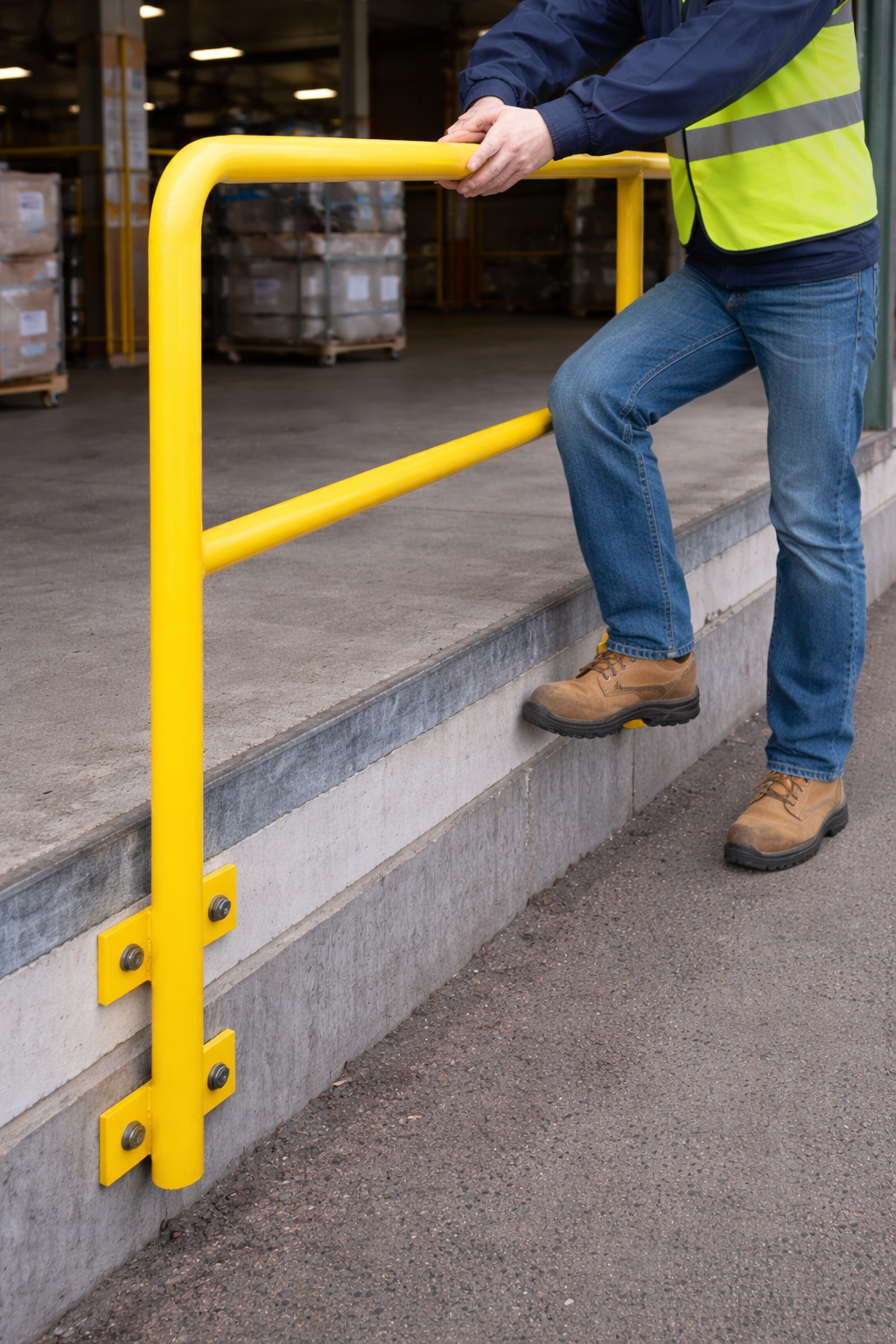
Industrial Safety Handrail UK 2026: Expert Guide to Workplace Protection
Industrial safety handrails in the UK represent one of the most critical investments facilities managers can make in 2026 to protect their workforce and ensure HSE compliance. As workplace safety regulations continue to evolve across England, Scotland, Wales, and Northern Ireland, choosing the right heavy-duty industrial safety handrail has never been more important for warehouses, loading bays, manufacturing plants, and distribution centres. This comprehensive guide examines everything UK facilities managers need to know about selecting, installing, and maintaining professional-grade safety handrail systems that deliver decades of reliable protection whilst meeting stringent Health and Safety Executive requirements throughout the United Kingdom.

Why Industrial Safety Handrails Matter in UK Workplaces 2026
The importance of robust fall protection systems in UK industrial environments cannot be overstated in 2026. With the Health and Safety Executive reporting thousands of workplace accidents annually related to falls from height and edge protection failures, investing in premium industrial safety handrails protects both your workforce and your business from devastating consequences.
Modern industrial operations across the UK face unique challenges including 24/7 operations, heavy forklift traffic, extreme weather exposure, and increasingly stringent regulatory requirements. A professional-grade safety handrail system addresses these challenges by providing:
- Legally compliant fall protection meeting current HSE guidelines across all UK jurisdictions
- Physical barriers preventing accidents at loading bays, mezzanine floors, and elevated walkways
- High-visibility warnings that enhance safety awareness in low-light industrial environments
- Impact resistance protecting both personnel and expensive equipment from collision damage
- Weather-resistant construction suitable for UK climate conditions from Scottish highlands to Welsh valleys
- Long-term cost savings through reduced accident rates, insurance premiums, and regulatory penalties
For NHS facilities, universities, manufacturing plants, and distribution centres throughout England, Scotland, Wales, and Northern Ireland, the right safety handrail system represents an essential component of comprehensive workplace protection strategies in 2026.
Understanding Industrial Safety Handrail Standards in the UK
UK industrial safety handrails must comply with specific Health and Safety Executive regulations governing fall protection, edge safety, and workplace barriers. In 2026, these requirements include precise specifications for height, load-bearing capacity, spacing, and structural integrity that vary based on application and risk assessment.
Key regulatory considerations include:
- Height specifications: Minimum heights typically range from 1100mm for standard applications to higher specifications for elevated platforms
- Load capacity: Systems must withstand specified horizontal and vertical loads without structural failure
- Spacing requirements: Mid-rails and toe boards must prevent falls and objects from passing through barriers
- Material standards: Construction materials must provide adequate strength, durability, and corrosion resistance
- Installation integrity: Mounting systems must maintain structural performance under operational conditions
- Maintenance protocols: Regular inspection and maintenance schedules ensure ongoing compliance
The heavy-duty industrial safety handrail from Price Cart UK is engineered to meet and exceed these comprehensive requirements, providing facilities managers with confidence in regulatory compliance and workforce protection.
Comparing Industrial Safety Handrail Options for UK Facilities
When evaluating safety handrail systems for UK industrial applications in 2026, facilities managers must consider multiple factors including material construction, finish durability, impact resistance, and total cost of ownership. The following comparison illustrates key differences between premium and standard options:
| Feature | Premium Steel Handrail | Standard Painted Steel | Plastic Barriers | Aluminium Systems |
|---|---|---|---|---|
| Material Construction | Premium-grade steel with reinforced joints | Basic steel, standard welding | Plastic composite | Aluminium alloy |
| Finish Durability | Powder-coated, 10+ year lifespan | Painted, 2-3 year lifespan | Moulded colour, fades quickly | Anodised, moderate durability |
| Impact Resistance | High - absorbs forklift impacts | Moderate - dents easily | Low - cracks on impact | Moderate - deforms under load |
| UK Weather Resistance | Excellent - climate tested | Fair - rust concerns | Poor - UV degradation | Good - corrosion resistant |
| HSE Compliance | Fully compliant, certified | Basic compliance | Limited applications | Compliant with limitations |
| Maintenance Requirements | Minimal - annual inspection | Regular repainting required | Frequent replacement | Periodic inspection |
| Expected Lifespan | 20+ years | 5-8 years | 3-5 years | 12-15 years |
| Total Cost of Ownership | Lowest over lifecycle | Moderate with maintenance | High due to replacement | Moderate to high |
This comparison demonstrates why premium steel construction with powder-coated finish represents the optimal choice for demanding UK industrial environments in 2026, delivering superior performance and value over the system's operational lifetime.
How to Choose the Right Industrial Safety Handrail for Your UK Facility
Selecting the appropriate safety handrail system requires careful assessment of your facility's specific requirements, operational conditions, and regulatory obligations. Follow this expert framework to make an informed decision:
1. Assess Your Application Requirements
- Identify all locations requiring fall protection including loading bays, walkways, mezzanines, and platform edges
- Measure exact perimeter dimensions and note any corners, angles, or custom configurations needed
- Evaluate traffic patterns including forklift routes, pedestrian access, and delivery vehicle movements
- Consider environmental exposure including weather conditions, chemical exposure, and temperature ranges
2. Verify Regulatory Compliance
- Review current HSE guidelines applicable to your industry and facility type across the UK
- Consult with safety inspectors regarding specific height, spacing, and load requirements
- Ensure selected systems provide appropriate certification and compliance documentation
- Consider insurance requirements and recommendations from your coverage provider
3. Evaluate Material and Construction Quality
- Prioritise premium-grade steel construction with reinforced joints for maximum durability
- Verify powder-coating specifications ensuring long-term finish integrity in UK climate conditions
- Assess impact resistance capabilities based on your facility's equipment and operational intensity
- Review manufacturer specifications for load-bearing capacity and structural performance
4. Calculate Total Cost of Ownership
- Compare initial purchase costs against expected lifespan and replacement frequency
- Factor in installation complexity, labour requirements, and operational disruption
- Account for ongoing maintenance costs including inspections, repairs, and refinishing
- Consider potential savings from reduced accidents, insurance premiums, and regulatory penalties
The industrial safety handrail from Price Cart UK excels across all these evaluation criteria, providing facilities managers throughout England, Scotland, Wales, and Northern Ireland with a proven solution for comprehensive workplace protection.
Step-by-Step Installation Guide for Industrial Safety Handrails
Proper installation is critical to ensuring your safety handrail system delivers optimal protection and regulatory compliance. Follow this professional installation methodology for best results:
Step 1: Pre-Installation Site Survey
Conduct thorough measurements of all perimeter areas requiring protection, documenting exact dimensions, surface conditions, and any obstacles or special requirements. Verify that mounting surfaces provide adequate load-bearing capacity and prepare detailed installation drawings showing post positions, corner configurations, and access points.
Step 2: Surface Preparation and Marking
Clean all mounting surfaces thoroughly, removing debris, oil, and loose material that could compromise anchor integrity. Mark precise post positions using chalk lines and measuring tools, ensuring consistent spacing and alignment throughout the installation run.
Step 3: Foundation and Anchor Installation
Drill anchor holes to specified depth using appropriate masonry bits for concrete or metal surfaces. Install chemical anchors or mechanical fixings according to manufacturer specifications, ensuring proper cure times for chemical systems before proceeding with structural loading.
Step 4: Vertical Post Assembly
Position vertical posts in prepared anchor points, checking plumb alignment with spirit level at multiple orientations. Secure base plates with appropriate fixings, torquing bolts to specified values. Install temporary bracing to maintain alignment during subsequent rail installation.
Step 5: Horizontal Rail Installation
Attach horizontal rails to posts using supplied brackets and fixings, working systematically from one end to the other. Ensure consistent height measurements and secure all connections to specified torque values, installing mid-rails and toe boards where required by HSE regulations.
Step 6: Corner and Junction Configuration
Install corner posts and junction pieces according to site-specific requirements, ensuring smooth transitions and maintaining structural integrity. Use appropriate angle brackets and reinforcement plates for directional changes, verifying alignment before final tightening.
Step 7: Final Inspection and Testing
Conduct comprehensive inspection of all connections, checking torque values, alignment, and stability. Test handrail strength by applying appropriate test loads, verifying compliance with HSE requirements. Remove temporary bracing and installation debris, leaving a clean, professional installation.
Step 8: Documentation and Certification
Complete installation records including anchor positions, torque specifications, and inspection results. Photograph completed installation for maintenance records and insurance documentation, providing site management with installation certificate and maintenance schedule recommendations.
Cost Analysis: Investing in Industrial Safety Handrails UK 2026
Understanding the true cost of industrial safety handrails requires analysis beyond initial purchase price to encompass total lifecycle value. In 2026, UK facilities managers should evaluate investments using this comprehensive framework:
Initial Investment Components:
- Material costs for handrail system components including posts, rails, brackets, and fixings
- Installation labour including site preparation, anchor installation, and system assembly
- Delivery and logistics for UK-wide distribution to England, Scotland, Wales, and Northern Ireland
- Engineering consultation for custom configurations and site-specific requirements
Ongoing Operational Costs:
- Annual inspection requirements ensuring HSE compliance and identifying maintenance needs
- Periodic cleaning and minor maintenance preserving finish quality and structural integrity
- Occasional repairs addressing impact damage or component wear over operational lifetime
- Documentation and record-keeping supporting regulatory compliance and insurance coverage
Avoided Costs and Benefits:
- Accident prevention reducing injury costs, productivity losses, and regulatory penalties
- Insurance premium reductions reflecting improved safety performance and risk management
- Equipment protection preventing costly damage from collisions and operational incidents
- Regulatory compliance avoiding fines, work stoppages, and legal liabilities
- Enhanced reputation supporting customer confidence and employee recruitment
When facilities managers calculate total cost of ownership over a 20-year operational period, premium industrial safety handrails consistently deliver superior value compared to cheaper alternatives requiring frequent replacement and ongoing maintenance.
Common Mistakes to Avoid When Implementing Safety Handrails
UK facilities managers can avoid costly errors and ensure optimal safety outcomes by recognising and preventing these common implementation mistakes:
Prioritising Initial Cost Over Lifecycle Value
Selecting the cheapest available option often results in premature failure, frequent replacements, and higher total costs. Premium construction delivers decades of reliable service, eliminating the false economy of budget alternatives that require replacement every 3-5 years.
Inadequate Site Assessment and Planning
Rushing installation without thorough site survey leads to improper sizing, inadequate anchor capacity, and configuration issues. Invest time in comprehensive planning to ensure first-time success and avoid expensive modifications after installation.
Compromising on Material Quality
Substituting inferior materials or finishes to reduce costs undermines long-term performance and safety effectiveness. Powder-coated steel construction provides essential durability for UK industrial environments, whilst painted or plastic alternatives deteriorate rapidly.
Neglecting Maintenance Requirements
Failing to implement regular inspection and maintenance schedules allows minor issues to escalate into major failures. Establish documented maintenance protocols ensuring ongoing compliance and maximising system lifespan.
Ignoring Environmental Conditions
Selecting systems unsuitable for UK weather conditions, chemical exposure, or operational intensity results in premature degradation. Ensure chosen solutions are specifically engineered for British industrial environments across all regions.
Improper Installation Techniques
Cutting corners during installation compromises structural integrity and regulatory compliance. Follow manufacturer specifications precisely, using appropriate tools, techniques, and quality control measures throughout the process.
Insufficient Documentation
Failing to maintain comprehensive installation and maintenance records creates compliance gaps and liability exposure. Document all aspects of system implementation, inspection, and maintenance for regulatory and insurance purposes.
Expert Recommendations for Industrial Safety Handrail Systems
Based on decades of combined experience in UK industrial safety applications, our expert recommendations for 2026 include:
For Loading Bay Applications: Prioritise impact-resistant construction with high-visibility yellow finish to withstand constant forklift traffic whilst maintaining safety awareness. The heavy-duty industrial safety handrail provides optimal protection for these demanding environments across the UK.
For Mezzanine Installations: Select modular systems enabling custom configurations that accommodate corners, angles, and access points whilst maintaining continuous protection. Ensure adequate height specifications and mid-rail spacing for fall prevention compliance.
For External Applications: Specify powder-coated steel construction engineered for UK climate conditions, providing superior corrosion resistance against moisture, temperature fluctuations, and environmental exposure from Scottish highlands to Welsh valleys.
For Multi-Location Deployments: Standardise on proven systems enabling consistent installation, maintenance, and compliance across facilities throughout England, Scotland, Wales, and Northern Ireland. Bulk procurement delivers cost efficiencies whilst ensuring uniform safety standards.
For NHS and Educational Facilities: Choose systems meeting stringent institutional requirements for safety, durability, and professional appearance. Premium construction demonstrates commitment to duty of care whilst supporting long-term budget management.
For High-Traffic Warehouses: Invest in reinforced construction capable of absorbing repeated impacts without structural compromise. Impact-resistant design protects both personnel and expensive equipment whilst maintaining continuous safety barriers.
Maintenance Tips for Long-Term Performance
Maximise the lifespan and effectiveness of your industrial safety handrail investment with these professional maintenance practices:
Monthly Visual Inspections:
- Walk entire perimeter checking for loose fixings, impact damage, or coating deterioration
- Tighten any loose bolts to specified torque values using calibrated tools
- Document findings in maintenance log with photographs of any concerns
- Address minor issues immediately to prevent escalation and maintain continuous protection
Quarterly Detailed Examinations:
- Perform thorough examination of all structural components including welds and joints
- Inspect powder coating for chips, scratches, or corrosion requiring touch-up
- Verify anchor integrity and mounting point condition across all posts
- Clean surfaces using mild detergent solution and soft brush, avoiding abrasive materials
Annual Professional Assessments:
- Engage qualified safety inspector for comprehensive structural assessment and load testing
- Verify ongoing HSE compliance and document inspection results for regulatory records
- Implement any recommended repairs or upgrades to maintain optimal performance
- Update maintenance schedules based on observed wear patterns and operational conditions
Incident Response Protocols:
- Inspect immediately following any impact incidents, checking for structural deformation
- Replace damaged sections promptly to maintain continuous protection
- Document incidents for safety records and insurance purposes
- Analyse incident patterns to identify opportunities for additional protective measures
These maintenance practices ensure your safety handrail system continues delivering reliable protection throughout its 20+ year operational lifetime across UK facilities.
Frequently Asked Questions About Industrial Safety Handrails UK
Q: Do industrial safety handrails meet current UK HSE requirements for fall protection in 2026?
A: Yes, properly specified industrial safety handrails engineered to HSE guidelines provide legally compliant fall protection for loading bays, elevated walkways, and platform edges. The system must incorporate appropriate height specifications, load-bearing capacity, and spacing requirements to satisfy regulatory inspections across England, Scotland, Wales, and Northern Ireland. Premium systems include certification documentation supporting compliance verification.
Q: What is the expected lifespan of industrial safety handrails in UK environments?
A: With proper installation and routine maintenance, premium-grade steel safety handrails deliver 20+ years of reliable service in demanding UK industrial environments. Powder-coated finishes resist corrosion, UV degradation, and environmental exposure, whilst robust steel construction withstands impacts and continuous use. Total cost of ownership calculations demonstrate exceptional value compared to inferior systems requiring frequent replacement.
Q: Can safety handrail systems be installed on existing concrete loading bays?
A: Absolutely. Modular safety handrail systems are specifically designed for retrofit installation on existing concrete surfaces, steel platforms, and composite structures. Versatile mounting systems accommodate various surface types with appropriate anchor systems for each application. Pre-drilled mounting points and comprehensive installation hardware ensure professional results with minimal operational disruption.
Q: How does powder-coated finish perform in outdoor UK weather conditions?
A: Professional-grade powder coating is specifically formulated for UK climate conditions, providing superior resistance to moisture, temperature fluctuations, and UV exposure. Unlike standard paint finishes that fade and deteriorate within 2-3 years, quality powder coating maintains vibrant visibility for 10+ years whilst protecting underlying steel from corrosion and environmental damage across all UK regions.
Q: What maintenance is required to keep safety handrails compliant and functional?
A: Industrial safety handrails require minimal ongoing maintenance, typically consisting of monthly visual inspections, quarterly cleaning, and annual professional assessment. Powder-coated finishes eliminate repainting requirements, whilst robust steel construction resists deformation and degradation. Most facilities find that routine inspections and occasional tightening of fixings represent the entirety of maintenance requirements.
Q: Can handrail systems accommodate corners, angles, and custom configurations?
A: Yes, modular designs incorporate corner posts, angle brackets, and junction pieces enabling custom configurations matching specific facility layouts. Whether protecting straight loading bay edges, L-shaped platforms, or complex perimeter routes, quality systems adapt to requirements whilst maintaining structural integrity and HSE compliance throughout all sections.
Q: Is fast delivery available across all UK regions including Scotland, Wales, and Northern Ireland?
A: Comprehensive UK-wide delivery covers England, Scotland, Wales, and Northern Ireland with expedited shipping options for urgent safety requirements. Reliable logistics networks ensure delivery to urban centres, rural locations, and remote industrial sites with tracking information and delivery coordination to minimise operational disruption.
Q: How do industrial safety handrails compare to alternative barrier systems?
A: Premium steel handrails with powder-coated finish significantly outperform plastic barriers, painted steel, and temporary systems in durability, impact resistance, weather performance, and total cost of ownership. The 20+ year lifespan and minimal maintenance requirements deliver superior value despite higher initial investment, whilst ensuring continuous HSE compliance and workforce protection.
Conclusion: Securing Your UK Facility with Industrial Safety Handrails in 2026
As we've explored throughout this comprehensive guide, industrial safety handrails in the UK represent a critical investment in workforce protection, regulatory compliance, and operational excellence for 2026 and beyond. From loading bays to mezzanine floors, from warehouse walkways to external platforms, premium safety handrail systems deliver decades of reliable fall protection whilst meeting stringent Health and Safety Executive requirements across England, Scotland, Wales, and Northern Ireland.
The evidence is clear: facilities managers who prioritise quality construction, proper installation, and routine maintenance achieve superior safety outcomes, reduced total cost of ownership, and enhanced regulatory compliance. By selecting heavy-duty industrial safety handrails engineered specifically for demanding UK industrial environments, you protect your most valuable assets—your people—whilst safeguarding your business from costly accidents, regulatory penalties, and operational disruptions.
Don't compromise on workplace safety or regulatory compliance in 2026. Invest in proven industrial safety handrail systems that deliver professional-grade protection, HSE compliance, and exceptional long-term value for UK facilities. With premium steel construction, high-visibility yellow finish, and proven durability in demanding environments, the right safety system represents an intelligent investment in workforce protection and operational excellence.
Ready to secure your facility with industry-leading safety protection? Explore the complete range of industrial safety handrails at Price Cart UK and benefit from fast UK-wide delivery, expert technical support, and the peace of mind that comes from premium British engineering. Contact our team today for site-specific guidance, custom configuration assistance, or volume pricing for multi-location installations across the United Kingdom. Protect your people, ensure compliance, and choose safety solutions that deliver uncompromising protection and lasting value.