
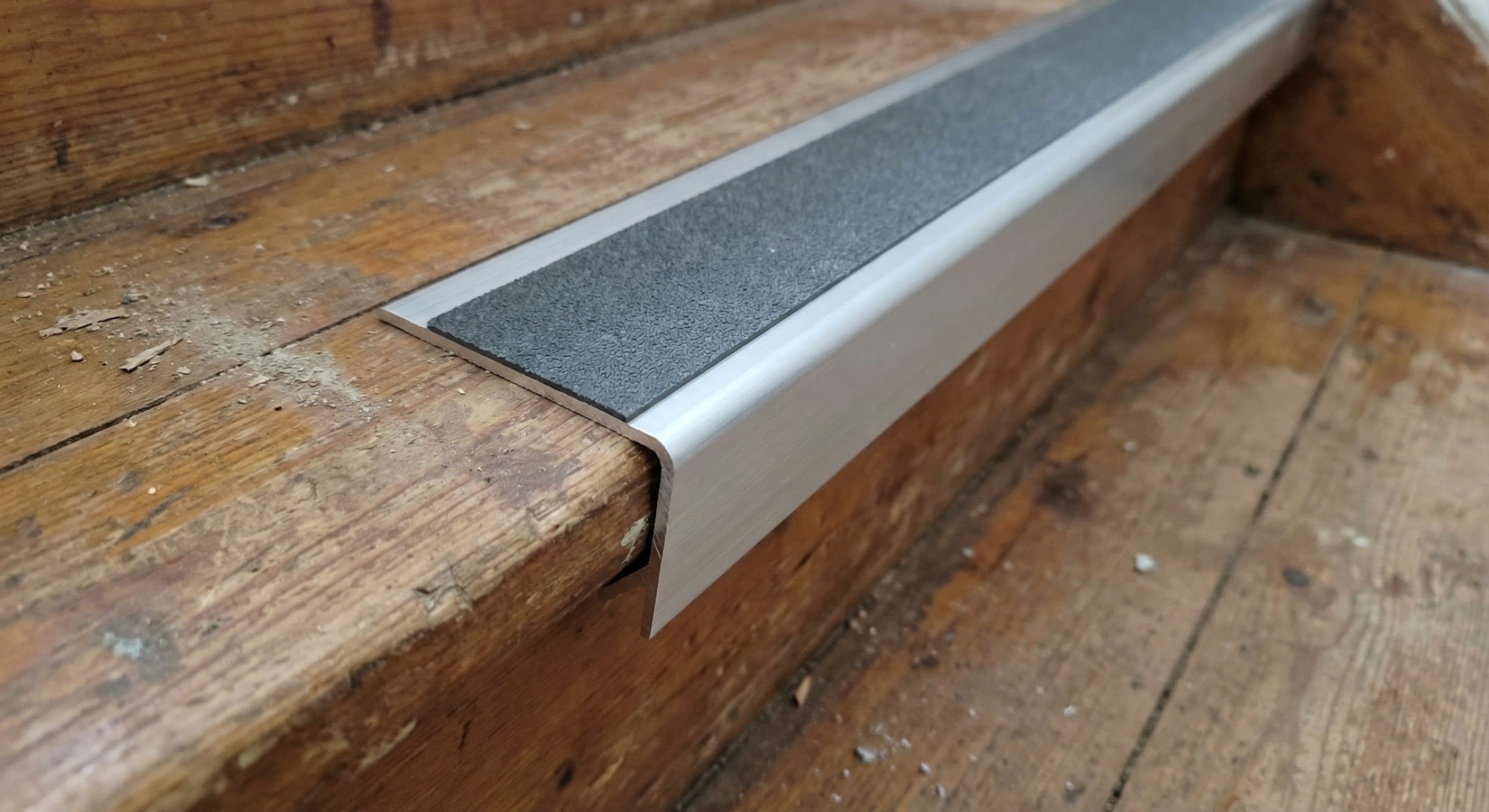
Aluminium Stair Nosing UK 2026: Ultimate Safety & Installation Guide

Aluminium stair nosing UK installations have become the gold standard for professional edge protection across England, Scotland, Wales, and Northern Ireland in 2026. Whether you're managing an NHS facility, educational institution, commercial property, or industrial warehouse, selecting the right aluminium stair nosing is critical for safety compliance, durability, and long-term cost efficiency. This comprehensive guide provides facility managers, contractors, and property owners across the United Kingdom with expert insights into specification, installation, maintenance, and performance optimisation of premium aluminium stair nosing systems.
The UK market in 2026 demands edge protection solutions that exceed British Standards whilst delivering measurable safety improvements and exceptional lifecycle value. Our premium 66×32mm rakeback aluminium stair nosing represents the culmination of engineering excellence and practical functionality, specifically designed for demanding UK environments from coastal Scotland to industrial England.
Why Aluminium Stair Nosing Matters for UK Facilities in 2026
Stair-related incidents remain a significant safety concern across UK facilities, with thousands of reportable accidents occurring annually in commercial, healthcare, and educational environments. Professional-grade aluminium stair nosing addresses this critical challenge through multiple safety mechanisms that protect building occupants whilst ensuring regulatory compliance.
The superior slip resistance provided by high-friction PVC inserts dramatically reduces accident risk in wet and dry conditions throughout England, Scotland, Wales, and Northern Ireland. Unlike painted or coated alternatives that wear smooth over time, quality aluminium stair nosing UK systems maintain consistent grip performance for decades.
Visual edge definition proves equally important for accident prevention. The contrasting white PVC insert creates clear stair edge demarcation, crucial for visually impaired users and low-light conditions common in UK commercial buildings. This high-visibility feature supports DDA compliance and accessibility requirements across the United Kingdom.
Structural edge protection extends stair lifespan significantly by preventing concrete spalling, timber splitting, and general wear deterioration. The robust aluminium profile distributes impact forces, protecting substrate integrity whilst maintaining aesthetic appeal throughout the operational lifetime of UK facilities.
Comprehensive Comparison: Aluminium vs Alternative Stair Nosing Materials
| Performance Factor | Premium Aluminium Nosing | Brass Nosing | Plastic Edge Trim | Rubber Nosing |
|---|---|---|---|---|
| Material Durability | Heavy-duty aluminium alloy – 20+ year lifespan in UK facilities | Tarnishes rapidly, requires regular polishing maintenance | Cracks under load, UV degradation, 3-5 year replacement cycle | Tears easily, 2-4 year lifespan in commercial environments |
| Non-Slip Performance | High-friction PVC insert – superior grip wet/dry conditions | Smooth metal surface – limited traction, polishing reduces grip | Wears smooth quickly in high-traffic UK applications | Good initially but degrades rapidly with foot traffic |
| UK Climate Resistance | Anodised finish – corrosion-proof in coastal/industrial UK locations | Oxidises in salt environments across Scotland, Wales, coastal England | UV degradation, brittleness in cold UK winters | Temperature sensitivity, hardens in cold, softens in heat |
| Load Capacity | Heavy-duty commercial-grade – withstands wheeled equipment | Moderate strength – residential applications only | Light-duty – unsuitable for UK warehouses or industrial sites | Poor load distribution – deforms under concentrated loads |
| Maintenance Requirements | Minimal – periodic cleaning maintains performance indefinitely | Regular polishing required to maintain appearance and safety | Frequent replacement needed, high lifecycle maintenance costs | Regular inspection and replacement in high-traffic UK areas |
| Installation Flexibility | Pre-drilled for concrete, timber, metal – all UK substrate types | Custom drilling required, limited substrate compatibility | Adhesive only – poor bond strength, installation failures common | Adhesive or mechanical – inconsistent performance across UK climates |
| Total Cost of Ownership | Excellent – long lifespan, minimal maintenance, no replacement costs | Moderate – maintenance labour costs accumulate over time | Poor – frequent replacement negates initial cost savings | Poor – short lifespan requires regular reinvestment |
| Fire Safety Compliance | Non-combustible – meets UK Building Regulations Part B | Non-combustible – compliant for UK applications | Combustible – restricted use in UK escape routes and public areas | Combustible – fire safety concerns in regulated UK environments |
The performance advantages of premium aluminium stair nosing become increasingly evident over the operational lifetime of UK facilities. Whilst initial investment may exceed basic alternatives, the superior durability, minimal maintenance requirements, and extended service life deliver exceptional total cost of ownership for facility managers across England, Scotland, Wales, and Northern Ireland.
How to Choose the Right Aluminium Stair Nosing for UK Applications
Selecting appropriate stair nosing requires careful evaluation of multiple technical and operational factors specific to your UK facility. The following criteria ensure optimal performance, compliance, and value:
Profile Dimensions and Rakeback Angle: The 66×32mm profile provides robust edge protection suitable for commercial and industrial UK applications. The rakeback angle must accommodate your flooring type whilst creating a smooth, compliant transition that eliminates trip hazards across England, Scotland, Wales, and Northern Ireland.
Substrate Compatibility: Verify the nosing system supports your stair construction material. Quality aluminium nosing accommodates concrete, timber, and metal substrates common throughout UK facilities, with appropriate fixing specifications for each application.
Length Options for UK Stair Widths: Standard UK residential stairs (900mm) require 1.0m lengths, whilst commercial installations (1200-2400mm) benefit from 1.5m, 2.0m, 2.46m, or 2.77m options. Selecting appropriate lengths minimises waste and simplifies installation across your UK property portfolio.
PVC Insert Specifications: High-friction PVC inserts must maintain grip performance throughout the product lifetime. Replaceable insert technology extends nosing lifespan whilst reducing long-term maintenance costs for UK facility managers.
Corrosion Resistance for UK Climates: Anodised aluminium finishes provide essential protection against moisture, salt exposure, and chemical environments common in coastal UK locations and industrial facilities across Scotland, Wales, Northern Ireland, and England.
Building Regulation Compliance: Ensure the nosing meets UK Building Regulations Part K (stair safety), Part M (accessibility), and Part B (fire safety). Certified products simplify specification for regulated environments including NHS hospitals, schools, and public buildings throughout the United Kingdom.
Load Rating for Application Type: Heavy-duty commercial-grade nosing withstands extreme foot traffic, wheeled equipment, and environmental stress in UK warehouses, distribution centres, and industrial facilities. Residential-grade alternatives fail prematurely in demanding applications.
Aesthetic Integration: Professional aluminium nosing maintains visual appeal whilst delivering safety performance. The clean, modern appearance suits contemporary UK commercial interiors across England, Scotland, Wales, and Northern Ireland.
Step-by-Step Professional Installation Guide for UK Contractors
Proper installation ensures optimal performance, safety compliance, and extended service life for aluminium stair nosing across UK facilities. Follow this comprehensive procedure for professional-quality results:
Step 1: Pre-Installation Assessment and Preparation
- Measure stair width accurately using a steel tape measure, recording dimensions for each tread requiring nosing installation across your UK facility
- Select appropriate nosing lengths to minimise waste whilst ensuring complete edge coverage for England, Scotland, Wales, and Northern Ireland applications
- Clean stair edges thoroughly, removing all debris, old adhesives, loose material, and contaminants that could compromise fixing integrity
- Verify substrate condition – repair any concrete spalling, timber rot, or metal corrosion before proceeding with nosing installation
- Ensure environmental conditions are suitable – substrate must be dry, and ambient temperature should exceed 5°C for optimal fixing performance in UK climates
Step 2: Accurate Positioning and Alignment
- Position the aluminium nosing flush with the stair edge, ensuring the rakeback profile aligns correctly with the tread surface geometry
- Use a spirit level to verify horizontal alignment across the full width – critical for professional appearance and safety performance
- Mark fixing hole positions using the pre-drilled holes as a template, ensuring even spacing and optimal load distribution
- Double-check alignment before drilling – repositioning after substrate penetration compromises installation quality in UK facilities
Step 3: Substrate-Specific Drilling Procedures
- For concrete stairs common in UK commercial buildings: Use 6mm masonry bit, drill to 40mm depth, clear dust from holes before fixing insertion
- For timber stairs in UK residential and heritage properties: Use 4mm wood bit, drill to 30mm depth, avoid over-tightening to prevent timber splitting
- For metal stairs in UK industrial facilities: Use 5mm HSS bit with cutting fluid, drill perpendicular to surface, deburr holes before fixing installation
- Ensure all holes are perpendicular to the stair surface – angled drilling reduces fixing strength and compromises long-term performance across England, Scotland, Wales, and Northern Ireland
Step 4: Secure Fixing Installation and Torque Control
- Insert appropriate fixings for substrate type – concrete plugs for masonry, wood screws for timber, metal fasteners for steel stairs throughout the UK
- Position nosing carefully, aligning all fixing holes before commencing fastener installation
- Hand-tighten fixings from the centre outward to prevent bowing and ensure even clamping pressure across the full length
- Torque to manufacturer specifications – typically 4-6 Nm for optimal clamping without aluminium deformation or substrate damage in UK applications
- Verify all fixings are flush with the nosing surface – protruding fasteners create trip hazards and compromise safety compliance
Step 5: PVC Insert Fitting and Seating Verification
- Clean the aluminium channel thoroughly, removing any installation debris, metal filings, or contaminants
- Press the PVC insert firmly into the channel, working systematically from one end to the other
- Ensure complete seating along the entire length with no gaps, raised sections, or loose areas that could compromise slip resistance
- Verify insert security by applying moderate pressure – properly seated inserts resist displacement under normal loading conditions across UK facilities
Step 6: Final Inspection and Quality Assurance
- Verify all fixings are secure, flush, and torqued to specification throughout your UK installation
- Check PVC insert is fully seated with no movement, gaps, or raised sections along the entire length
- Test edge alignment and ensure no trip hazards exist at the nosing-to-tread transition
- Clean installation area thoroughly, removing all debris, tools, and materials before reopening stairs to traffic in England, Scotland, Wales, and Northern Ireland facilities
- Document installation date, product specifications, and maintenance schedule for facility management records
Comprehensive Cost Analysis for UK Facility Managers
Understanding the total cost of ownership for aluminium stair nosing enables informed specification decisions across UK property portfolios. This analysis compares initial investment, maintenance costs, and lifecycle expenses:
Initial Investment Considerations: Premium aluminium stair nosing typically costs £25-45 per linear metre for UK installations, varying with profile dimensions, length options, and order quantities. Bulk purchases for multi-site facilities across England, Scotland, Wales, and Northern Ireland benefit from volume pricing that reduces per-unit costs significantly.
Installation Labour Costs: Professional installation by UK contractors averages £15-25 per linear metre, depending on substrate type, access constraints, and project scale. Facilities teams with appropriate tools and training can complete installations in-house, eliminating external labour costs whilst maintaining quality standards.
Maintenance Cost Projections: Minimal maintenance requirements translate to negligible ongoing costs for UK facility managers. Periodic cleaning using standard pH-neutral detergents costs approximately £0.50-1.00 per linear metre annually. PVC insert replacement every 5-7 years in commercial environments costs £8-12 per linear metre, extending total nosing lifespan to 20+ years.
Replacement Cost Avoidance: Quality aluminium nosing eliminates the frequent replacement cycles required for plastic, rubber, and low-grade alternatives. Over a 20-year operational period, facilities using premium nosing avoid 4-6 replacement cycles, saving £100-180 per linear metre across UK installations.
Accident Cost Reduction: Improved slip resistance and edge visibility reduce stair-related incidents, avoiding the substantial costs associated with workplace accidents, insurance claims, and regulatory investigations throughout England, Scotland, Wales, and Northern Ireland.
Total Cost of Ownership Comparison: Whilst premium aluminium nosing requires higher initial investment than basic alternatives, the 20+ year lifespan, minimal maintenance requirements, and accident prevention benefits deliver superior total cost of ownership for UK facility managers. A typical 100-metre installation costs £4,000-7,000 initially but provides £15,000-25,000 in lifecycle value compared to frequent replacement of inferior products.
Common Mistakes to Avoid in UK Stair Nosing Projects
Facility managers and contractors across England, Scotland, Wales, and Northern Ireland frequently encounter preventable installation and specification errors that compromise performance, safety, and cost efficiency:
Selecting Residential-Grade Products for Commercial UK Applications: Light-duty nosing fails rapidly under commercial foot traffic and wheeled equipment loading. Always specify heavy-duty commercial-grade aluminium nosing for NHS facilities, schools, warehouses, and office buildings throughout the United Kingdom.
Inadequate Substrate Preparation: Installing nosing over contaminated, damaged, or unstable substrates guarantees premature failure. Thorough cleaning, repair, and preparation ensure optimal fixing integrity across UK facilities.
Incorrect Fixing Specifications: Using inappropriate fasteners for substrate type compromises installation security. Concrete requires masonry plugs, timber needs wood screws, and metal substrates demand specific fasteners – mixing fixing types causes failures in UK installations.
Over-Tightening or Under-Tightening Fixings: Excessive torque deforms aluminium profiles and damages substrates, whilst insufficient tightening allows movement and loosening. Follow manufacturer torque specifications for optimal clamping across England, Scotland, Wales, and Northern Ireland applications.
Ignoring UK Climate Considerations: Coastal locations across Scotland, Wales, and Northern Ireland require enhanced corrosion resistance. Specifying standard finishes for salt-exposure environments leads to premature deterioration and replacement costs.
Neglecting Building Regulation Compliance: Non-compliant nosing creates liability exposure and regulatory violations in UK commercial, healthcare, and educational facilities. Always verify products meet British Standards for stair safety, accessibility, and fire performance.
Failing to Plan PVC Insert Replacement: Even premium nosing requires eventual insert replacement in high-traffic UK environments. Establishing maintenance schedules and budgeting for insert renewal prevents performance degradation and safety compliance issues.
Inadequate Length Planning: Ordering incorrect lengths creates waste and installation complications. Accurate measurement and appropriate length selection minimise material costs and simplify fitting across UK property portfolios.
Expert Recommendations for Optimal UK Performance
Decades of experience with stair safety solutions across England, Scotland, Wales, and Northern Ireland inform these professional recommendations for facility managers and contractors:
Prioritise Quality Over Initial Cost: Premium aluminium stair nosing delivers superior lifecycle value despite higher upfront investment. The 20+ year lifespan and minimal maintenance requirements far outweigh the modest cost premium over inferior alternatives in UK applications.
Implement Proactive Maintenance Schedules: Quarterly inspections identify minor issues before they escalate into safety hazards or costly repairs. Document inspection findings and maintenance activities to demonstrate due diligence across your UK facility portfolio.
Standardise Specifications Across Multi-Site Portfolios: Using consistent nosing specifications throughout your UK properties simplifies procurement, installation, and maintenance whilst ensuring uniform safety standards across England, Scotland, Wales, and Northern Ireland.
Engage Experienced UK Contractors for Large Projects: Professional installation ensures building regulation compliance, optimal performance, and warranty validity. Vet contractors thoroughly, verifying experience with similar UK facilities and substrate types.
Plan for Future Insert Replacement: Budget for PVC insert renewal in 5-7 year cycles for commercial UK environments. Proactive replacement maintains slip resistance and prevents safety compliance issues before performance degradation becomes evident.
Document Installation Details Comprehensively: Maintain records of product specifications, installation dates, contractor details, and maintenance activities. This documentation supports warranty claims, regulatory compliance, and informed decision-making for UK facility managers.
Consider Aesthetic Integration: Aluminium nosing should complement your facility's design aesthetic whilst delivering safety performance. The clean, professional appearance suits contemporary UK commercial interiors across all sectors.
Professional Maintenance Tips for Maximum Lifespan
Proper maintenance extends the operational life of aluminium stair nosing whilst maintaining optimal safety performance across UK facilities:
Routine Cleaning Protocol: Clean weekly with pH-neutral detergent and warm water, avoiding abrasive cleaners that damage anodised finishes. For high-traffic UK facilities including NHS hospitals, schools, and commercial buildings, increase cleaning frequency to maintain appearance and slip resistance throughout England, Scotland, Wales, and Northern Ireland.
PVC Insert Inspection Schedule: Inspect quarterly for wear, damage, or loosening. The PVC insert should maintain firm seating and high-friction surface characteristics. Replace insert if grip performance diminishes or visible wear exceeds 2mm depth in UK applications.
Fixing Security Verification: Conduct annual inspections of fixing security, particularly in high-vibration environments common in UK industrial facilities. Re-torque loose fixings immediately using appropriate tools and torque specifications. Replace any corroded or damaged fasteners with equivalent specification components.
Substrate Condition Monitoring: Inspect stair substrate condition during routine maintenance activities. Address concrete spalling, timber rot, or metal corrosion promptly to prevent nosing displacement and safety hazards across your UK property portfolio.
Performance Documentation: Record maintenance activities, inspection findings, and component replacements in facility management systems. This documentation demonstrates regulatory compliance and informs lifecycle planning for UK facility managers.
Long-Term Performance Optimisation: Monitor performance in high-traffic areas across your UK facility, identifying patterns that inform maintenance scheduling and replacement planning. Plan PVC insert replacement every 5-7 years in commercial environments, 10-15 years in residential applications throughout England, Scotland, Wales, and Northern Ireland.
Frequently Asked Questions – UK Stair Nosing Expertise
What makes aluminium stair nosing suitable for UK healthcare facilities?
Premium aluminium nosing meets stringent NHS and healthcare standards for hygiene, durability, and safety across England, Scotland, Wales, and Northern Ireland. The non-porous aluminium construction resists bacterial growth, whilst the high-friction PVC insert provides superior slip resistance crucial for patient and staff safety. The low-maintenance design reduces lifecycle costs for UK healthcare facility managers, and the robust construction withstands intensive cleaning protocols and wheeled equipment traffic common in medical environments.
How does the rakeback design benefit UK building regulation compliance?
The intelligent rakeback profile creates a smooth, compliant transition between stair treads, eliminating trip hazards whilst accommodating various flooring types including carpet, vinyl, and hard surfaces. This professional design feature meets UK Building Regulations Part M (accessibility) and Part K (stair safety), making it ideal for commercial, public, and residential projects throughout the United Kingdom. The angled profile also facilitates drainage and cleaning in UK facilities.
Can aluminium stair nosing withstand heavy wheeled equipment in UK warehouses?
Absolutely. The heavy-duty 66×32mm aluminium profile is engineered for extreme loading conditions common in UK distribution centres and industrial facilities. The robust construction resists deformation from pallet trucks, trolleys, and heavy foot traffic, maintaining safety performance for 20+ years in demanding environments across England, Scotland, Wales, and Northern Ireland. The professional-grade material specifications ensure structural integrity under concentrated loads that would destroy plastic or rubber alternatives.
What length should I specify for standard UK stair widths?
For typical UK residential stairs (900mm width), specify 1.0m length with minimal trimming required. For commercial stairs (1200mm width), choose 1.5m or 2.0m lengths depending on exact dimensions. For wide public access stairs common in UK schools and hospitals (2400mm+), select 2.46m or 2.77m options. Multiple lengths can be joined for extra-wide installations, though single-piece coverage provides superior appearance and performance across England, Scotland, Wales, and Northern Ireland.
How does aluminium nosing perform in coastal UK locations with salt exposure?
The anodised aluminium finish provides exceptional corrosion resistance, making this nosing ideal for coastal properties across Scotland, Wales, Northern Ireland, and coastal England. Unlike brass or steel alternatives that corrode rapidly in salt-laden environments, premium aluminium maintains structural integrity and appearance for decades in marine climates. The protective anodised layer prevents oxidation and pitting that compromise inferior materials in UK coastal applications.
Is professional installation required, or can UK facilities teams fit this nosing?
Competent facilities teams can install aluminium nosing using standard tools and comprehensive UK installation guidance. The pre-drilled holes and straightforward fixing method enable rapid, professional-quality installation without specialist equipment. For large-scale projects across multiple UK sites, we recommend engaging experienced contractors to ensure consistent quality and building regulation compliance throughout England, Scotland, Wales, and Northern Ireland.
What warranty coverage applies to UK installations?
Comprehensive warranty coverage protects UK installations against manufacturing defects and premature failure. The aluminium profile carries extended warranty protection reflecting the 20+ year design life, whilst the PVC insert is covered for normal wear under specified conditions. Specific warranty terms apply to installations across England, Scotland, Wales, and Northern Ireland – contact our UK technical team for detailed coverage information and registration procedures.
How often should PVC inserts be replaced in high-traffic UK facilities?
In commercial UK environments including NHS hospitals, schools, and office buildings, plan for PVC insert replacement every 5-7 years to maintain optimal slip resistance. Residential applications typically require replacement every 10-15 years. High-traffic areas may require more frequent renewal – quarterly inspections identify wear patterns that inform replacement scheduling across your UK facility portfolio in England, Scotland, Wales, and Northern Ireland.
Conclusion: Invest in Proven UK Stair Safety Excellence
Aluminium stair nosing UK installations represent a critical investment in facility safety, regulatory compliance, and long-term cost efficiency across England, Scotland, Wales, and Northern Ireland. The superior performance, durability, and lifecycle value of premium 66×32mm rakeback aluminium stair nosing make it the professional choice for NHS facilities, educational institutions, commercial properties, and industrial sites throughout the United Kingdom in 2026.
By following the expert guidance, installation procedures, and maintenance protocols outlined in this comprehensive guide, UK facility managers and contractors can maximise safety performance, ensure building regulation compliance, and optimise total cost of ownership across their property portfolios. The proven track record of quality aluminium nosing in demanding UK environments demonstrates the measurable benefits of investing in professional-grade edge protection technology.
Don't compromise on stair safety for your UK facility. Order premium aluminium stair nosing today and experience the difference that engineering excellence, superior materials, and expert design make for your England, Scotland, Wales, or Northern Ireland property. Fast UK delivery ensures your safety upgrade project proceeds without delay, protecting building occupants and delivering peace of mind for facility managers across the United Kingdom.
Transform your stair safety standards with professional-grade aluminium edge protection that delivers decades of reliable performance. Contact our UK technical team today for specification assistance, volume pricing, and delivery scheduling tailored to your facility's requirements.