
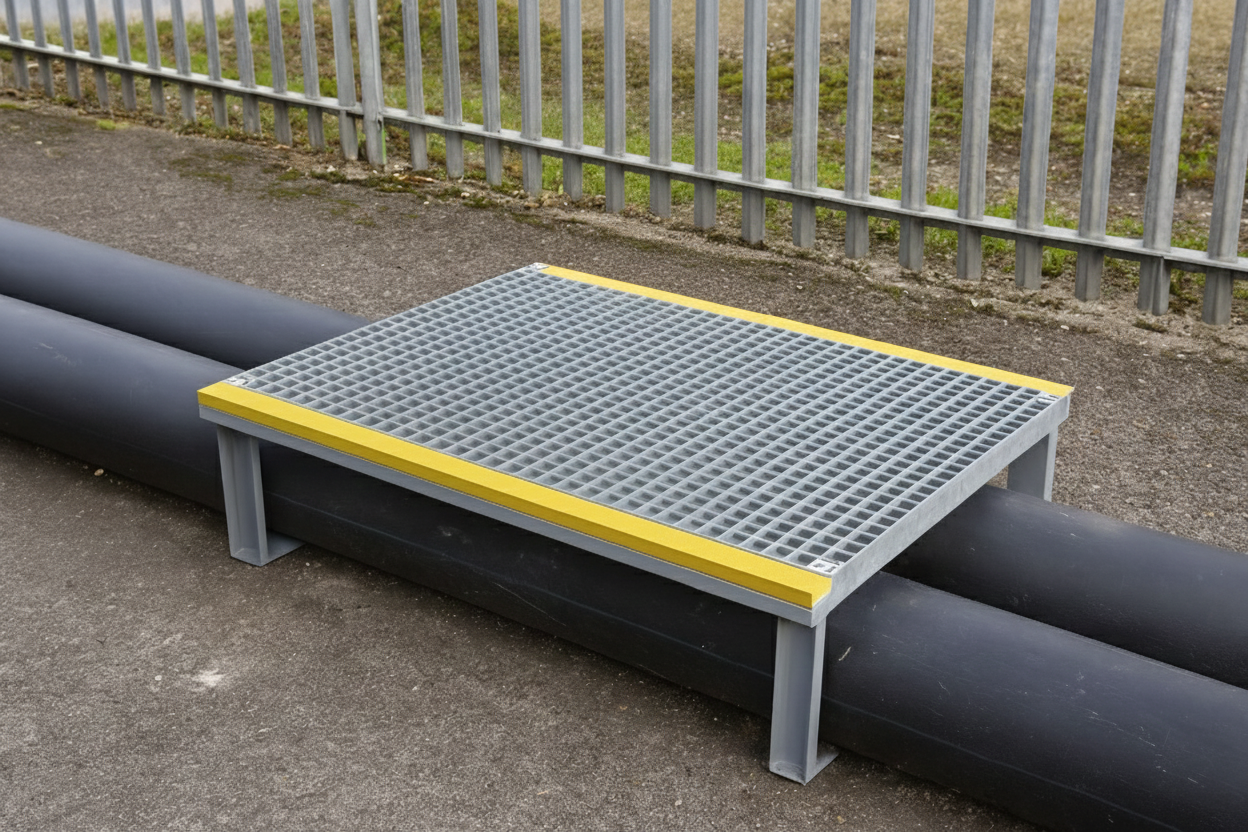

GRP step-over platforms UK facilities are revolutionising industrial safety across England, Scotland, Wales, and Northern Ireland in 2026. When navigating pipes, cables, and low obstructions in warehouses, laboratories, and manufacturing plants, professional-grade GRP step-over platforms deliver maintenance-free, corrosion-proof access solutions that outperform traditional metal alternatives. This comprehensive guide examines why glass-reinforced plastic platforms have become the definitive choice for UK industrial facilities seeking long-term safety, durability, and cost-effectiveness in 2026.
As facilities managers across the United Kingdom face increasing pressure to reduce maintenance costs whilst enhancing workplace safety, the shift toward advanced composite materials represents a fundamental change in industrial access infrastructure. This expert resource provides evidence-based insights into GRP platform technology, comparative performance data, and practical implementation guidance for professional decision-makers.
Why GRP Step-Over Platforms Matter for UK Industrial Facilities in 2026
The industrial landscape across England, Scotland, Wales, and Northern Ireland has evolved significantly, with safety regulations, maintenance budgets, and operational efficiency demands driving facilities managers toward smarter infrastructure investments. Traditional steel and aluminium platforms that dominated the market for decades now represent a costly liability rather than a long-term solution.
GRP step-over platforms address three critical challenges simultaneously: eliminating corrosion-related failures, reducing total cost of ownership, and providing superior non-slip safety performance. For NHS facilities, universities, manufacturing plants, and utilities operators throughout the UK, these platforms deliver measurable improvements in safety metrics, maintenance expenditure, and operational uptime.
The material science behind glass-reinforced plastic creates inherent advantages that cannot be replicated through coatings or treatments on metal platforms. The composite structure resists chemical attack, moisture penetration, and UV degradation whilst maintaining structural integrity across temperature extremes common in British industrial environments. This translates to 20+ year service lives with virtually zero maintenance—a compelling value proposition for budget-conscious facilities managers in 2026.
Understanding GRP Technology: Material Science Behind Superior Performance
Glass-reinforced plastic combines high-strength glass fibres with thermosetting resin matrices to create a composite material that exhibits exceptional mechanical properties whilst remaining lightweight and corrosion-proof. The manufacturing process embeds the reinforcement fibres in precise orientations, optimising strength-to-weight ratios for industrial access applications.
The non-slip surface texture is moulded directly into the platform during fabrication, creating an integral safety feature that cannot wear away like applied coatings. This manufacturing approach ensures consistent grip performance throughout the platform's service life, even in wet, oily, or contaminated conditions common in UK industrial facilities.
Electrical insulation properties inherent to GRP provide an additional safety margin in environments where personnel may encounter live electrical equipment or cabling. Unlike conductive metal platforms, GRP platforms eliminate shock hazards, making them ideal for substations, electrical rooms, and utilities infrastructure across the United Kingdom.
Comprehensive Comparison: GRP vs Steel vs Aluminium Platforms
Professional facilities managers require objective performance data to justify infrastructure investments. The following comparison examines key performance criteria across platform materials based on real-world UK industrial applications in 2026:
| Performance Criteria | GRP Platform | Steel Platform | Aluminium Platform |
|---|---|---|---|
| Corrosion Resistance | Excellent – inherent material property | Poor – requires protective coatings | Moderate – oxidises without treatment |
| Maintenance Requirements | None – maintenance-free operation | Regular painting, rust treatment | Periodic cleaning, coating renewal |
| Weight (typical 2m span) | 15-20 kg – lightweight | 45-60 kg – heavy | 18-25 kg – lightweight |
| Non-Slip Performance | Integral – permanent texture | Applied coating – wears off | Applied coating – wears off |
| Electrical Insulation | Yes – non-conductive | No – highly conductive | No – conductive |
| Chemical Resistance | Excellent – resists most chemicals | Poor without protective coating | Moderate – limited resistance |
| Expected Service Life | 20+ years | 5-10 years (with maintenance) | 10-15 years |
| Total Cost of Ownership (10 years) | Low – no maintenance costs | High – multiple replacements/repainting | Moderate – periodic maintenance |
The data clearly demonstrates why GRP step-over platforms have become the professional choice for UK facilities prioritising long-term value and operational efficiency in 2026.
How to Choose the Right GRP Platform for Your UK Facility
Selecting the optimal platform configuration requires careful assessment of your specific application requirements. Consider these critical factors when specifying GRP step-over platforms for industrial facilities across England, Scotland, Wales, and Northern Ireland:
- Span Requirements: Measure the obstruction width accurately, allowing for clearance on both sides. Standard platforms accommodate spans from 600mm to 2400mm, with custom configurations available for specialised applications.
- Height Clearance: Determine the required step height based on the obstruction dimensions and ergonomic access considerations. Typical heights range from 150mm to 600mm for industrial applications.
- Load Capacity: Assess the anticipated foot traffic and equipment transport requirements. Standard GRP platforms support 300-500 kg distributed loads, with heavy-duty configurations available for demanding applications.
- Environmental Conditions: Evaluate exposure to chemicals, temperature extremes, UV radiation, and moisture. GRP excels in harsh environments where metal platforms fail prematurely.
- Installation Constraints: Consider mounting surface types, available fixing points, and installation access. The lightweight construction of GRP simplifies installation in challenging locations.
- Regulatory Compliance: Verify that platform specifications meet relevant UK safety standards and industry-specific requirements for your sector.
Step-by-Step Installation Guide for GRP Platforms
Professional installation ensures optimal performance and safety. Follow this comprehensive procedure for installing GRP step-over platforms in UK industrial facilities:
- Site Assessment and Planning: Conduct a thorough evaluation of the installation location, measuring obstruction dimensions, identifying suitable mounting surfaces, and verifying clearances. Document all measurements and create a detailed installation plan.
- Tools and Materials Preparation: Assemble required tools including drill with appropriate bits, spanners or socket set, spirit level, tape measure, and marking tools. Select fixings appropriate for your substrate—typically M10 or M12 stainless steel bolts with expansion anchors for concrete, or structural bolts for steel mounting points.
- Platform Positioning: Place the platform in its intended location and verify clearances on all sides. Use a spirit level to ensure the platform will be level when installed. Mark fixing hole locations on the mounting surface through the platform's pre-drilled holes.
- Drilling and Anchor Installation: Remove the platform and drill fixing holes to the appropriate depth and diameter for your chosen anchors. Install expansion anchors or prepare threaded mounting points as required, ensuring they are properly seated and secure.
- Platform Mounting: Position the platform and insert fixing bolts. Hand-tighten initially to allow for final positioning adjustments. Verify the platform is level and properly aligned before proceeding.
- Final Torquing: Torque fixings to the manufacturer's specification (typically 40-50 Nm for M10 bolts) using a calibrated torque wrench. Follow a cross-pattern tightening sequence to ensure even loading.
- Quality Inspection: Conduct a final inspection to ensure all fixings are secure, the platform is stable under load, and there are no sharp edges or protrusions. Test the platform with representative loading before releasing for operational use.
- Documentation: Record installation details including date, installer identification, torque values, and any site-specific considerations. Maintain records for future reference and compliance audits.
Cost Analysis: Total Cost of Ownership for UK Facilities
Understanding the true cost of industrial access platforms requires analysis beyond initial purchase price. The total cost of ownership over a typical 10-year period reveals the superior value proposition of GRP technology:
GRP Platform (10-Year TCO):
- Initial purchase: £450-£750 (depending on size)
- Installation labour: £100-£150
- Maintenance costs: £0 (maintenance-free)
- Replacement costs: £0 (20+ year service life)
- Total 10-Year Cost: £550-£900
Steel Platform (10-Year TCO):
- Initial purchase: £350-£600
- Installation labour: £150-£200 (heavier, more complex)
- Painting/coating (every 2 years): £200 × 5 = £1,000
- Replacement (year 8): £350-£600
- Second installation: £150-£200
- Total 10-Year Cost: £2,000-£2,600
Aluminium Platform (10-Year TCO):
- Initial purchase: £500-£800
- Installation labour: £100-£150
- Coating renewal (every 3 years): £150 × 3 = £450
- Maintenance inspections: £200
- Total 10-Year Cost: £1,250-£1,600
The analysis demonstrates that whilst GRP platforms may have a slightly higher initial cost, they deliver the lowest total cost of ownership over their service life. For facilities managers across the UK managing multiple platforms, the cumulative savings become substantial in 2026 and beyond.
Common Mistakes to Avoid When Specifying Industrial Platforms
Professional facilities managers can avoid costly errors by recognising these common specification and installation mistakes:
- Focusing Solely on Initial Price: Selecting the cheapest option without considering maintenance costs, replacement frequency, and operational disruption leads to higher total expenditure over time.
- Underestimating Environmental Factors: Failing to account for chemical exposure, moisture, temperature extremes, or UV radiation results in premature platform failure and unexpected replacement costs.
- Inadequate Load Assessment: Specifying platforms without proper load analysis creates safety risks and potential structural failures when actual usage exceeds design capacity.
- Improper Installation: Using incorrect fixings, inadequate torque values, or unsuitable mounting surfaces compromises platform stability and safety performance.
- Neglecting Electrical Hazards: Installing conductive metal platforms in electrical environments creates unnecessary shock risks that could be eliminated with non-conductive GRP alternatives.
- Ignoring Maintenance Requirements: Failing to budget for ongoing painting, coating renewal, and rust treatment on metal platforms leads to deteriorated safety performance and compliance issues.
- Overlooking Lifecycle Costs: Making decisions based on capital expenditure alone without considering operational costs, maintenance burden, and replacement frequency.
Expert Recommendations for UK Industrial Facilities in 2026
Based on extensive experience with industrial access solutions across England, Scotland, Wales, and Northern Ireland, these expert recommendations guide professional facilities managers toward optimal platform selection:
For Chemical and Pharmaceutical Facilities: Specify GRP platforms exclusively due to superior chemical resistance and non-reactive properties. The material withstands aggressive cleaning agents and process chemicals that rapidly degrade metal alternatives.
For Electrical Environments: Prioritise GRP for its inherent electrical insulation properties. In substations, electrical rooms, and utilities infrastructure, the non-conductive characteristics provide an additional safety margin that metal platforms cannot offer.
For Coastal and Marine Applications: GRP is the only viable long-term solution for saltwater exposure. Metal platforms in coastal UK facilities require constant maintenance and frequent replacement, making GRP the cost-effective choice.
For Food Processing and Pharmaceutical Manufacturing: The smooth, non-porous GRP surface resists bacterial growth and facilitates thorough cleaning, meeting stringent hygiene standards whilst withstanding aggressive sanitisation protocols.
For Budget-Conscious Facilities: Despite higher initial costs, GRP delivers superior ROI through eliminated maintenance and extended service life. For facilities managing multiple platforms, the cumulative savings justify the investment.
For Outdoor Industrial Sites: UV-resistant GRP formulations maintain structural integrity and aesthetic appearance throughout decades of outdoor exposure across all UK climates, from coastal Scotland to industrial England.
Maintenance Tips for Long-Term GRP Platform Performance
Whilst GRP platforms are virtually maintenance-free, following these guidelines ensures optimal long-term performance across UK industrial facilities:
- Routine Cleaning: Remove accumulated dirt, debris, or contamination quarterly using water and mild detergent. Pressure washers can be used for stubborn deposits, but avoid excessive pressure that might damage the surface texture.
- Quarterly Visual Inspections: Check that fixing bolts remain tight and that there's no visible damage to the platform structure. Verify that the non-slip surface remains effective and that there are no cracks, chips, or delamination.
- Annual Load Testing: Conduct annual load tests to verify structural integrity, particularly in high-traffic applications or environments with aggressive chemical exposure.
- Fixing Verification: Re-torque fixing bolts annually to manufacturer specifications, particularly in high-vibration environments or locations subject to thermal cycling.
- Damage Assessment: Any visible damage should be assessed by a competent person to determine if repair or replacement is required. Document all inspections and maintenance activities for compliance records.
- Chemical Compatibility: If new chemicals or cleaning agents are introduced to your facility, verify compatibility with GRP materials to ensure continued performance.
Frequently Asked Questions About GRP Step-Over Platforms UK
What is the typical weight capacity of GRP step-over platforms for UK industrial use?
Standard GRP platforms are engineered for 300-500 kg distributed loads, suitable for industrial foot traffic and typical equipment transport. Heavy-duty configurations supporting higher capacities are available for specialised applications. Specific load ratings depend on platform dimensions and span—consult technical specifications for your exact requirements.
Can GRP platforms withstand outdoor conditions across England, Scotland, Wales, and Northern Ireland?
Absolutely. GRP is formulated to resist UV exposure, temperature cycling, and moisture without degradation. These platforms perform reliably in outdoor installations across all UK climates, from coastal environments to inland industrial sites. The material won't rust, rot, or become brittle over decades of outdoor service.
How does the non-slip performance of GRP compare to coated metal platforms?
The non-slip texture in GRP platforms is moulded into the material itself during fabrication, not applied as a coating. This integral design means it cannot wear off or degrade over time, providing consistent safety performance throughout the platform's 20+ year service life—far superior to applied coatings that require periodic renewal.
Are GRP platforms suitable for chemical processing and pharmaceutical facilities?
Yes. GRP offers excellent resistance to a wide range of industrial chemicals, acids, alkalis, and solvents. This makes these platforms ideal for chemical processing, pharmaceutical manufacturing, laboratories, and other environments where metal platforms would corrode rapidly. For specific chemical compatibility questions, technical resistance data is available.
What is the typical delivery time for GRP platforms to UK facilities in 2026?
Standard delivery to England, Scotland, Wales, and Northern Ireland typically takes 3-5 working days from stock. For urgent requirements or large orders, expedited delivery options are available to minimise operational disruption.
Can GRP platforms be customised for specific UK industrial applications?
Whilst standard platforms suit most applications, custom dimensions and configurations are available for specialised requirements. Custom-engineered designs can accommodate unique span requirements, load capacities, or environmental conditions specific to your facility.
How do GRP platforms compare in cost to steel alternatives for UK facilities?
Whilst the initial purchase price of GRP may be 20-30% higher than basic steel platforms, the total cost of ownership is significantly lower. When you eliminate maintenance, painting, and premature replacement, GRP delivers superior value over its 20+ year service life—typically 50-60% lower total cost compared to steel alternatives.
What safety certifications do GRP platforms meet for UK industrial use?
Professional-grade GRP platforms comply with relevant UK safety standards for industrial access equipment. Specific certifications vary by manufacturer and application—verify that your selected platform meets industry-specific requirements for your sector.
Conclusion: The Professional Choice for UK Industrial Access in 2026
GRP step-over platforms UK facilities represent the definitive solution for industrial access challenges across England, Scotland, Wales, and Northern Ireland in 2026. The combination of maintenance-free operation, corrosion-proof construction, superior non-slip safety, and exceptional lifecycle value makes GRP the professional choice for facilities managers prioritising long-term performance and cost-effectiveness.
As demonstrated through comprehensive performance comparisons, total cost of ownership analysis, and real-world UK industrial applications, GRP platforms outperform traditional metal alternatives across every critical criterion. From NHS facilities and universities to manufacturing plants and utilities infrastructure, organisations throughout the United Kingdom are making the strategic shift toward advanced composite access solutions.
Don't compromise on safety or accept the ongoing maintenance burden of outdated metal platforms. Invest in professional-grade GRP step-over platforms that deliver decades of reliable, maintenance-free performance. Order now for fast UK delivery and experience the difference that evidence-based industrial access solutions make to your facility's safety, operational efficiency, and bottom line in 2026.