
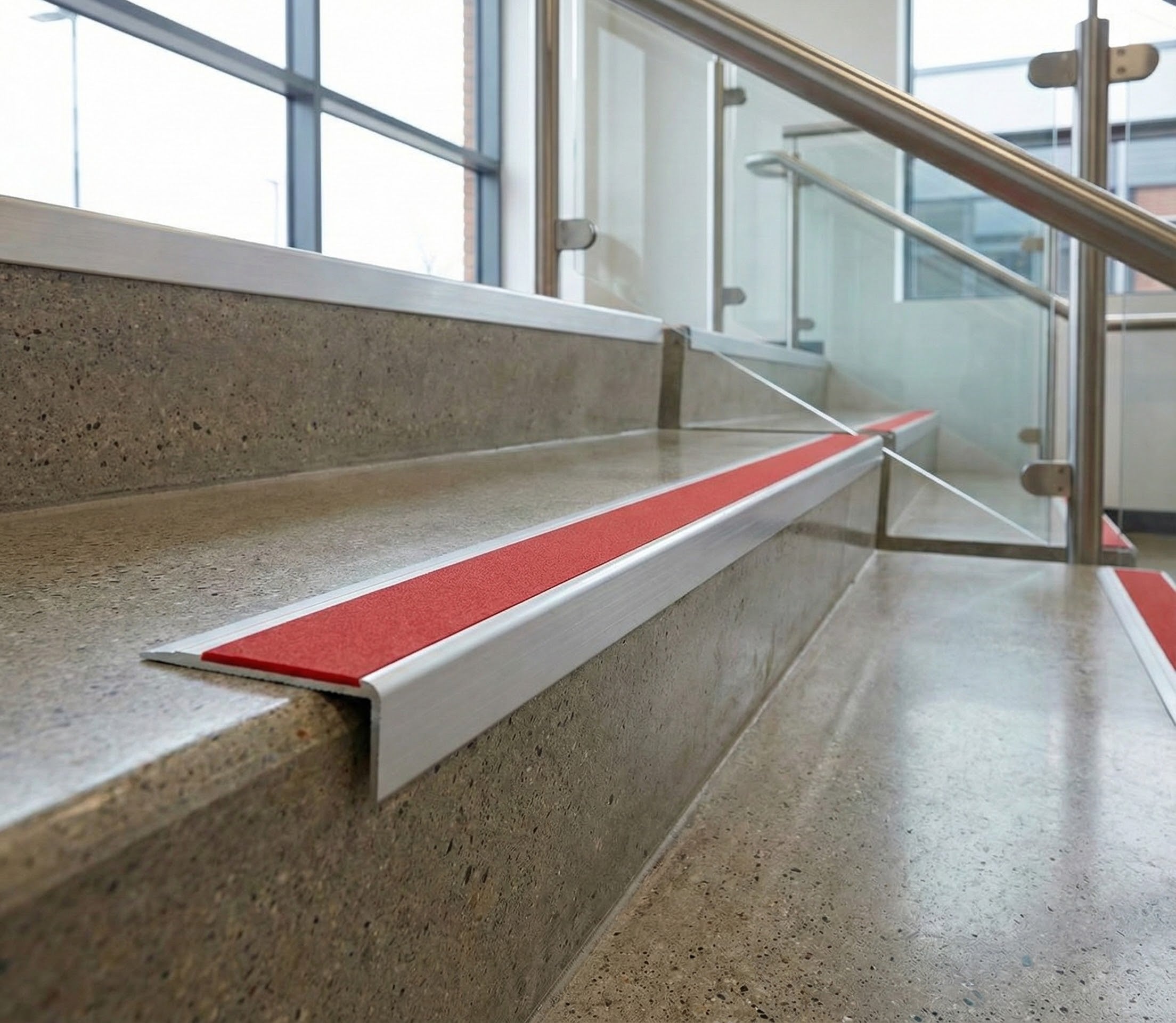
Anti-Slip Stair Nosing UK 2026: Ultimate Safety Guide
Anti-slip stair nosing UK installations have become essential safety features for properties across England, Scotland, Wales, and Northern Ireland in 2026. Whether you're managing a commercial facility, industrial warehouse, healthcare environment, or residential property, professional-grade aluminium anti-slip stair nosing delivers the ultimate protection against slips, trips, and falls whilst ensuring compliance with UK building regulations and accessibility standards.
This comprehensive expert guide explores everything UK property professionals need to know about selecting, installing, and maintaining premium anti-slip stair nosing solutions in 2026. From understanding the critical safety benefits to comparing product options and mastering professional installation techniques, you'll discover why thousands of UK facilities trust heavy-duty aluminium stair nosing with high-traction PVC inserts for long-term safety performance.
Why Anti-Slip Stair Nosing Matters for UK Properties in 2026
Stair-related accidents remain one of the leading causes of workplace injuries and domestic incidents across the United Kingdom, with the Health and Safety Executive (HSE) reporting thousands of serious injuries annually. In 2026, UK property owners face increasing regulatory scrutiny, higher insurance premiums for unsafe premises, and significant legal liability for preventable accidents. Professional anti-slip stair nosing UK installations address these critical challenges whilst protecting your most valuable assets – your people.
The demanding UK climate presents unique challenges for stair safety. Persistent rainfall across Wales and Scotland, coastal salt spray in English seaside towns, harsh winter conditions throughout Northern Ireland, and temperature fluctuations nationwide create hazardous conditions on staircases. Premium aluminium anti-slip stair nosing with ramp profile delivers consistent all-weather performance, maintaining exceptional grip even when wet, icy, or contaminated.
Beyond immediate safety benefits, professional stair nosing demonstrates your commitment to duty of care obligations, supports compliance with the Equality Act 2010 through wheelchair-accessible ramp profiles, and protects against costly insurance claims and legal action. For commercial properties, educational institutions, healthcare facilities, and public buildings across the UK, anti-slip stair nosing represents an essential investment in risk management and regulatory compliance.
Comprehensive Comparison: Premium vs Standard Stair Nosing Solutions
Not all anti-slip stair nosing products deliver equal performance, durability, or value. Understanding the critical differences between premium professional-grade solutions and standard market alternatives helps UK property managers make informed decisions that protect both people and budgets over the long term.
| Feature | Premium Aluminium Anti-Slip Nosing | Standard Plastic Nosing | Basic Rubber Nosing |
|---|---|---|---|
| Material Quality | Heavy-duty extruded aluminium with professional-grade PVC insert | Thin plastic extrusion, prone to cracking | Basic rubber compound, degrades quickly |
| Expected Lifespan | 20+ years with minimal maintenance | 3-5 years before replacement required | 2-4 years in high-traffic areas |
| Slip Resistance | Professional all-weather high-traction, effective when wet | Limited effectiveness in wet conditions | Becomes slippery when contaminated |
| Load Capacity | Heavy-duty industrial specification, withstands trolleys & equipment | Light domestic use only, deforms under load | Moderate capacity, compresses over time |
The comparison clearly demonstrates why professional UK facilities choose premium aluminium anti-slip stair nosing. Whilst initial costs may be higher than basic alternatives, the exceptional 20+ year lifespan, minimal maintenance requirements, and superior safety performance deliver outstanding return on investment for properties across England, Scotland, Wales, and Northern Ireland.
How to Choose the Right Anti-Slip Stair Nosing for UK Applications
Selecting appropriate anti-slip stair nosing UK solutions requires careful consideration of your specific application, environment, traffic levels, and regulatory requirements. Follow this expert framework to ensure optimal product selection:
1. Assess Your Environment and Climate Exposure
Indoor installations in controlled environments have different requirements than outdoor staircases exposed to UK weather. For outdoor applications across Scotland, Wales, England, and Northern Ireland, prioritise marine-grade aluminium construction with weather-resistant PVC inserts that maintain performance in rain, frost, and coastal conditions.
2. Evaluate Traffic Levels and Load Requirements
High-traffic commercial premises, industrial facilities, and public buildings require heavy-duty specifications that withstand constant use, trolleys, cleaning equipment, and wheelchairs. Residential properties with moderate foot traffic can use the same professional-grade products for exceptional longevity and reliability.
3. Consider Accessibility and Compliance Needs
Properties serving the public or employing staff must comply with UK accessibility legislation including the Equality Act 2010 and Building Regulations Approved Document M. Ramp profile designs create smooth transitions for wheelchair users whilst eliminating trip hazards for all users.
4. Determine Substrate Compatibility
Verify that your chosen anti-slip stair nosing works with your existing stair construction – concrete, wood, metal, tiles, or stone. Premium aluminium solutions offer universal compatibility with flexible fixing systems that adapt to diverse UK property types from Victorian buildings to modern developments.
5. Calculate Long-Term Value and Total Cost of Ownership
Compare not just initial purchase prices but total lifecycle costs including installation, maintenance, and replacement frequency. Professional-grade aluminium anti-slip stair nosing delivers superior value through decades of reliable service with minimal upkeep.
Step-by-Step Professional Installation Guide for UK Properties
Proper installation ensures optimal safety performance, longevity, and compliance with UK building standards. Follow this comprehensive professional installation process:
Step 1: Gather Required Tools and Materials
Assemble your electric drill with appropriate bits (masonry, HSS, or wood depending on substrate), screwdriver or impact driver, tape measure, carpenter's pencil, hacksaw or angle grinder, metal file, spirit level, safety glasses, and suitable fixings for your stair material.
Step 2: Prepare the Stair Surface Thoroughly
Clean the stair edge completely using a stiff brush and vacuum to remove all dirt, dust, and debris. For outdoor UK installations, ensure the surface is completely dry. Repair any damage to existing stair edges and measure the exact width at multiple points to account for irregularities.
Step 3: Cut Nosing to Precise Length
Mark the required length on your aluminium stair nosing using a straight edge. Cut using a fine-tooth hacksaw or angle grinder with metal cutting disc, cutting slightly long (1-2mm) then filing to exact fit. Deburr all cut edges thoroughly for safe handling and professional appearance.
Step 4: Position and Align Accurately
Place the stair nosing on the edge with the ramp profile facing upward and the high-traction PVC insert on the horizontal tread surface. Position with 5-10mm overhang on the riser for optimal visual definition. Use a spirit level to ensure perfect horizontal alignment across the entire width.
Step 5: Mark and Drill Fixing Points
Mark through pre-drilled countersunk holes onto the stair surface. Typical spacing is 150-200mm between fixings with fixings 50mm from each end. Drill pilot holes using appropriate bits – masonry bit for concrete/stone (40-50mm deep), wood bit for timber, or HSS bit for metal stairs.
Step 6: Secure with Professional Fixings
Insert wall plugs for masonry substrates. Reposition the nosing carefully, aligning all holes. Insert screws and tighten progressively from centre outward for even pressure distribution. Tighten firmly but avoid over-tightening which may distort the aluminium. Countersunk screws should sit flush or slightly below the surface.
Step 7: Conduct Final Quality Inspection
Verify firm securing with no movement under pressure. Check all fixings are tight and properly countersunk. Ensure the PVC insert is properly seated with no gaps or lifting. Confirm the ramp profile creates smooth transitions with no trip hazards. Test the anti-slip surface to ensure it's clean and ready for immediate use.
Cost Analysis: Investment and Long-Term Value for UK Properties
Understanding the true cost of anti-slip stair nosing UK installations requires analysis beyond initial purchase prices. Professional-grade solutions deliver exceptional value through extended lifespan, minimal maintenance, and accident prevention benefits.
Initial Investment Considerations
Premium aluminium anti-slip stair nosing typically costs £15-35 per metre depending on profile size and specification, with professional installation adding £10-20 per metre for labour. A typical commercial staircase with 12 steps at 1.2m width requires approximately 14.4 metres of nosing, representing an initial investment of £360-800 including professional fitting.
Long-Term Maintenance and Replacement Savings
With a 20+ year lifespan and minimal maintenance requirements (simple cleaning only), premium solutions eliminate the frequent replacement costs associated with inferior products. Standard alternatives requiring replacement every 3-5 years cost significantly more over a 20-year period when accounting for materials, labour, and business disruption.
Accident Prevention and Liability Protection
The average workplace slip/trip accident costs UK businesses £8,000-15,000 in lost productivity, insurance claims, and potential legal fees. A single prevented accident pays for comprehensive stair nosing installation across an entire facility. For properties across England, Scotland, Wales, and Northern Ireland, this represents substantial risk mitigation value.
Insurance and Compliance Benefits
Demonstrating proactive safety measures through professional anti-slip stair nosing installation may reduce insurance premiums, supports regulatory compliance, and protects against liability claims. These ongoing benefits compound over decades of use.
Common Mistakes to Avoid with Stair Nosing Installation
Even experienced contractors and property managers can make critical errors that compromise safety performance and longevity. Avoid these common mistakes when installing anti-slip stair nosing across UK properties:
- Choosing inappropriate products for the environment: Using indoor-rated products on outdoor UK staircases exposed to weather leads to rapid degradation and safety failures. Always specify marine-grade aluminium with weather-resistant inserts for external applications.
- Inadequate surface preparation: Installing over dirty, damaged, or unstable substrates prevents proper adhesion and fixing security. Thorough cleaning and substrate repair are essential for professional results and long-term performance.
- Incorrect ramp profile orientation: Installing the ramp profile backward creates trip hazards rather than eliminating them. The gradual slope must face upward with the PVC insert on the horizontal tread surface.
- Insufficient fixing density: Spacing fixings too far apart (over 200mm) or omitting end fixings allows movement, lifting, and eventual failure. Follow manufacturer specifications for fixing patterns and density.
- Over-tightening fixings: Excessive torque distorts aluminium profiles, creates stress points, and may crack the material. Tighten firmly but avoid over-tightening, particularly with impact drivers.
- Neglecting expansion gaps: Long continuous runs without expansion joints may buckle under temperature changes. For runs exceeding 3 metres, consult manufacturer guidance on expansion joint requirements.
- Using incompatible fixings: Mismatched fixings for substrate type (wood screws in masonry, for example) fail to provide adequate security. Always use appropriate fixings for your specific stair construction material.
Expert Recommendations for Maximum Safety Performance
Drawing on decades of experience with UK property safety solutions, these expert recommendations ensure optimal anti-slip stair nosing performance across England, Scotland, Wales, and Northern Ireland:
Prioritise Quality Over Initial Cost
Professional-grade aluminium solutions with high-traction PVC inserts deliver superior long-term value despite higher upfront costs. The 20+ year lifespan and minimal maintenance requirements make premium products the most cost-effective choice for UK properties.
Ensure Comprehensive Coverage
Install anti-slip nosing on all staircases throughout your facility, not just high-traffic areas. Accidents occur on infrequently used stairs, fire escapes, and secondary access routes. Comprehensive coverage demonstrates thorough duty of care and eliminates liability gaps.
Combine with Complementary Safety Measures
Anti-slip stair nosing works best as part of integrated safety systems including adequate lighting, handrails, visual contrast marking, and regular maintenance programmes. This layered approach maximises protection for all users.
Document Installation and Maintenance
Maintain detailed records of installation dates, product specifications, maintenance schedules, and inspection findings. This documentation supports regulatory compliance, insurance requirements, and demonstrates due diligence in legal proceedings.
Schedule Professional Inspections
Quarterly visual inspections and annual comprehensive assessments by qualified professionals ensure ongoing safety performance, identify emerging issues before they become hazards, and extend product lifespan through proactive maintenance.
Maintenance Tips for Long-Term Performance in UK Conditions
Proper maintenance ensures your aluminium anti-slip stair nosing delivers decades of reliable service across demanding UK environments:
- Weekly cleaning routine: Wipe surfaces with damp microfibre cloth and mild pH-neutral detergent to remove dirt accumulation and maintain optimal slip resistance, particularly in high-traffic areas.
- Monthly deep cleaning: Use soft-bristled brush with warm soapy water to clean PVC insert grooves thoroughly, preventing debris build-up that could reduce traction performance over time.
- Quarterly fixing inspections: Check all fixings remain tight and secure, inspect PVC inserts for wear or damage, and examine aluminium for any issues particularly in high-traffic zones.
- Annual comprehensive assessment: Conduct thorough inspection of all installed nosing, document condition, verify compliance with current standards, and plan any necessary maintenance or replacement.
- Winter weather management: Remove ice, snow, and frost promptly using plastic scrapers (never metal). The anti-slip properties remain effective in cold UK conditions, but clearing frozen precipitation maintains optimal performance.
- Avoid damaging cleaning products: Never use abrasive cleaners, wire brushes, bleach, strong acids, alkalis, or solvent-based products that may damage aluminium finish or degrade PVC inserts.
Frequently Asked Questions About Anti-Slip Stair Nosing UK
What is the best anti-slip stair nosing for outdoor use in the UK?
Marine-grade aluminium anti-slip stair nosing with weather-resistant PVC inserts delivers optimal performance for outdoor UK applications. This professional specification withstands persistent rain, frost, coastal salt spray, and temperature fluctuations across England, Scotland, Wales, and Northern Ireland whilst maintaining consistent slip resistance in all weather conditions.
How long does aluminium stair nosing last in high-traffic areas?
Premium aluminium anti-slip stair nosing typically delivers 20+ years of reliable service in high-traffic commercial environments with proper installation and routine maintenance. The heavy-duty construction resists wear, maintains structural integrity, and continues providing professional-grade safety performance throughout its extended lifespan.
Does anti-slip stair nosing comply with UK building regulations?
Yes, professional-grade aluminium anti-slip stair nosing with ramp profile design meets UK building regulations, HSE guidance, and relevant British Standards including accessibility requirements under the Equality Act 2010 and Building Regulations Approved Document M for both commercial and residential applications.
Can I install stair nosing myself or do I need a professional?
Competent DIY enthusiasts can achieve professional results following comprehensive instructions, particularly for residential applications. However, commercial installations, high-traffic areas, and properties serving the public benefit from professional fitting by qualified contractors to ensure optimal safety performance and proper liability coverage.
What maintenance does anti-slip stair nosing require?
Minimal maintenance is required – simply wipe clean with mild detergent and water weekly in high-traffic areas, conduct quarterly visual inspections, and perform annual comprehensive assessments. The high-traction PVC insert maintains slip resistance without special treatments or re-surfacing throughout its lifespan.
Is stair nosing suitable for wheelchair accessibility?
Yes, ramp profile anti-slip stair nosing creates smooth gradual transitions that enable wheelchair users, mobility scooter users, and those with walking aids to navigate more safely whilst eliminating trip hazards for all users. This design supports compliance with UK accessibility legislation.
How much does professional stair nosing installation cost in the UK?
Professional installation typically costs £25-55 per metre including materials and labour, depending on stair type, location, and project complexity. A typical commercial staircase installation ranges from £360-800, representing excellent value considering the 20+ year lifespan and accident prevention benefits.
What types of stairs can accept anti-slip nosing?
Premium aluminium anti-slip stair nosing works with virtually all stair types including concrete, wood, metal, ceramic tiles, stone, and composite materials commonly found in UK properties from Victorian buildings to modern commercial developments. The only requirement is a sound, stable substrate capable of accepting mechanical fixings.
Conclusion: Invest in Professional Safety for UK Properties in 2026
Anti-slip stair nosing UK installations represent essential safety infrastructure for properties across England, Scotland, Wales, and Northern Ireland in 2026. From preventing costly accidents and protecting vulnerable users to ensuring regulatory compliance and demonstrating duty of care, professional-grade aluminium stair nosing delivers comprehensive benefits that extend far beyond the initial investment.
The demanding UK climate, increasing regulatory scrutiny, and growing awareness of accessibility requirements make 2026 the ideal time to upgrade your property's stair safety systems. Premium aluminium anti-slip stair nosing with high-traction PVC insert and ramp profile combines heavy-duty construction, all-weather performance, wheelchair accessibility, and exceptional longevity to deliver outstanding long-term value.
Don't compromise on safety or accept inferior alternatives that require frequent replacement and deliver inconsistent performance. Protect your people, secure your property, ensure compliance, and invest in professional-grade solutions that work reliably for decades. Order your premium aluminium anti-slip stair nosing today and experience the Price Cart UK difference – where quality, safety, and long-term value come together for UK property professionals who refuse to compromise.